
Sunday, July 09, 2006

Gene Expression Differences in Males and Females

What makes men and women different? Gene expression, of course! A new paper has just come out in the journal Genome Research that reports extensive sex differences in gene expression. The researchers found that thousands of genes in liver, fat and muscle tissue, and hundreds of genes in brain, are expressed differently in males and females. The study looked at mice genes, but the implication is that many of these differences will hold for humans as well.

Men and women share almost identical genomes - all of us have two copies of chromosomes 1-22, and at least one X chromosome. Differences in genes between men and women are limited to a relatively small number of genes on the Y chromosome. So how do sex differences arise? The answer must be in gender differences in gene regulation. These differences are not only responsible for most of the differences in sex characteristics, but also for many of the gender differences in susceptibility to certain diseases and responses to drugs.

Scientists at UCLA looked at genes in 4 major tissue types that are frequently involved in disease: brain, fat, liver, and muscle tissue. Among the genes that were active in those tissues, they found thousands of genes whose expression was sexually dimorphic, or different in males and females. The most dramatic differences were in liver, fat, and muscle cells, but hundreds of genes also showed expression differences in brain tissue. In brain tissue, 13% of the active genes showed sex differences, while in the other 3 tissue types, more than 50% of active genes showed differences.

Interestingly, sexually dimorphic genes were also genes that tended to be tissue specific. For example, some genes that are active in brain tissue are also active in many other tissues types; other genes are active only in the brain and nowhere else - these latter genes are tissue-specific genes. The researchers found that genes active in brain but nowhere else, or liver but nowhere else, etc., were the genes that showed the greatest differences between males and females. This suggests that most sexually dimorphic genes have highly specialized functions.

Most of the expression differences were small - most genes showed less than a 20% difference in expression level. How significant is this? It's hard to say - in many cases that much of a difference may not matter, but there can be situations where this difference alters the kinetics of a process in the cell and leads to gender differences in drug responses or disease development. Many of the genes that showed differences were enzymes, ion-conducting channels, and cell surface receptors, where small differences in expression could conceivably matter.

What does this all mean? What have we learned from this? Large gene expression studies like this don't always produce groundbreaking, concrete findings. Studies like this are most valuable for the new avenues of research they open up, and the data from this study will provide a resource for future, more specific studies. This is not the first paper to report gender differences in gene expression, but this study does show that these differences are much more extensive than we may have realized before. As I mentioned above, this kind of work lays a foundation for understanding why men and women differ in the incidence and progression of many major diseases.

An important question to ask when you look at the results of any research is, How did the researchers know what they claim to know? As I mentioned, this is not the first study to look at gender specific differences in gene expression, but this study is different in two major ways. The authors used over 300 mice (169 females, 165 males), which increases the statistical power of this study - they are able to reliably detect much smaller differences than previous studies. They also used the offspring of a cross between two fairly different strains of mice, as opposed to earlier studies that worked with one inbred strain. The advantage of this is that they are better able to link specific gene expression differences with certain physiological traits that differ between the two mouse strains. I won't go into the technical reasons why this is true - that's a little too much to deal with in this post.

You may be asking just what exactly are "differences in gene expression" and how do you measure these for thousands of genes at a time? In a study like this one, gene expression is defined as differences in the RNA levels. The level of RNA produced from a DNA-encoded gene is really only a proxy for what actually matters physiologically, the level of protein that is ultimately produced. In many cases, RNA can be a pretty good proxy, and RNA levels are much, much easier to measure because you can measure them on a a microarray. Here is how it works:

Step 1: Kill the mice, get the tissue, grind it up and chemically extract the RNA. Researchers have to be careful at this point to avoid cross contamination - for example, you don't want fat tissue in your muscle sample, although in some cases it's probably impossible to avoid all contamination. Also, in this paper the authors took general tissue types, like whole brain tissue, without separating out sub-types, so their results represent a tissue average and will not capture fine-scale expression differences in specialized parts of the brain.

Step 2: Make fluorescently labeled DNA from the RNA. RNA can act as a template to make DNA, and for reasons that will be clear later, you can use this step to incorporate fluorescent tags. When you use microarrays to look at gene expression, you need two samples for each experiment - a test sample (in this case, tissue from an individual male or female mouse), and a control sample which you can compare the test sample against. In this paper the control consisted of a mixed pool of RNA from both male and female mice, which gives an across-the-board average.


Step 3: Put your fluorescent DNA on the microarray and measure the fluorescence. The fluorescent DNA from the samples matches up, or hybridizes to short segments of DNA that have been printed as spots on a chip; each spot contains DNA for one gene, and a chip containst thousands of genes. The test sample has one kind of fluorescent tag (we'll call it red) and the control sample has another kind (we'll call it green). For each spot you measure how much red fluorescence and how much green fluorescence there is; the readout tells you whether there are more molecules from the test sample or the control sample hybridized to a particular spot. If there is more red on a spot, it means there were more RNA molecules from that gene in the test sample than in the control, and thus that the gene is more highly expressed in the test sample than in the control.

Here is the hybridization at one spot:
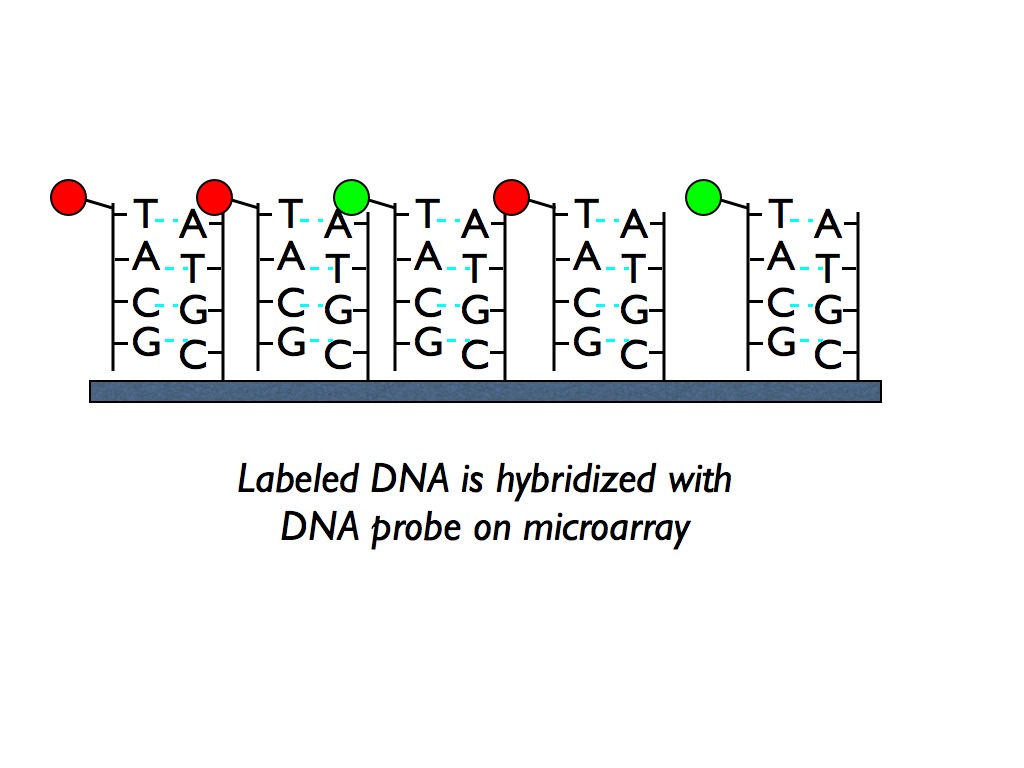


And here is a cartoon version of a microarray (remember, a real one has thousands of spots):


That, in a nutshell, is how you measure gene expression for thousands of genes. Remember, the readout is relative expression - all you can say is how strongly or weakly a gene is expressed in one sample relative to another sample. Measuring absolute levels of RNA requires different technologies, and those technologies haven't yet been adapted for measuring thousands of genes at once.

So after the authors did these experiments for ~300 individual mice (4 samples per mouse - a brain, fat, liver, and muscle sample), they could sit down and analyze their data. One way to represent the data is in a clustering analysis, as shown below:


Here is how you read this diagram. It's hard to see this, but the image is made up of several thousand red or green pixels. Each individual pixel represents one individual gene in one individual mouse; the pixel is red if the gene is expressed higher than average in that individual mouse, and green if lower than average. In this plot we are looking at ~40 individual genes, and you can see that these particular genes are expressed higher than average in almost all of the males and lower than average in almost all of the females.

Leaving out a lot of details, that's the general idea of how to measure differences in gene expression on a genome-wide scale.

Wednesday, July 05, 2006

National Review Supports Creationism

The National Review has published an article (this link is to a free version, the page also has a link to the article on the NR site) that demonstrates just how intellectually vacuous right-wingers can be. (Read other blog posts about it here and here.) Of course almost all creationists are going to be conservative because of their fundamentalist religious views, but what I don’t understand is why other conservatives who claim to have intellectually sound opinions on policy should align themselves with a movement as intellectually bankrupt and dishonest as intelligent design creationism. This is a fight they just aren’t going to win, any more than one could win a crusade against quantum mechanics or general relativity. Evolution is real science, and even if somehow creationists managed to get it out of the public school curriculum (which is unlikely, since creationists have lost essentially every court decision on the issue for the last 40 years), there is just no way research will stop on what is an extremely successful bedrock foundation of biology. The National Review and like-minded conservatives won’t break evolutionary biology with this stuff, they will only break their own intellectual credibility.

This article, “Evolution and Me” by George Gilder is what typically results when someone with no real scientific training in biology tries to debunk a technical field like evolutionary biology. Sometimes people seem to forget that science really is hard; this means that it takes a lot of time and effort and at least some formal training to be able to speak intelligently about even basic, textbook-level stuff. To be able to seriously critique the technical details of current research requires even more effort - you not only need a lot of background knowledge that scientists spend years in grad school acquiring, but you also have read and understand the latest papers and conference talks on the subject. Scientists generally aren’t stupid (at least about their own field), and it is really, really, really unlikely that someone with no training in biology will come up with a worthwhile idea that hasn’t already been thought of and tried by a working biologist. I’m not trying to be elitist - this is simply the reality in a tough, competitive profession.

It’s no surprise then that George Gilder, who has no training in biology, goes on in this article to make a complete fool of himself in his attempt to take down evolution. Much of article in fact isn’t even about evolution (or Darwinism, as he always refers to it, which makes about as much sense as referring to quantum mechanics as ‘Schrödingerism’). Gilder, like any good creationist, has to link evolution with Nazism, feminism, Planned Parenthood, and various economic theories that have no basis in the science of evolution. As Richard Feynman said (referring especially to the Uncertainty Principle), “in any case that I have ever seen of any of the philosophical ideas of the sciences dragged out into another field, it's completely distorted, a trivial shadow of its original idea, and it seems in some respects to be quite silly." It's also usually just just plain wrong. That doesn’t stop Gilder.

The main thrust of Gilder’s piece is to argue that information theory logically shows that evolution is impossible. Before looking at the details of this argument, I should point out that if real scientists did find that information theory implies that evolution couldn’t occur, they would see this as an indication that information theory is flawed and needs to be revised. Not because scientists dogmatically cling to evolution; it’s because the overwhelming physical evidence for evolution would trump a construct like information theory, and as in all good science, theories are tested against evidence. The other problem with Gilbert’s whole approach is that he thinks that biologists have ignored information theory, and therefore they have missed its implications. Remember what I said above - that it’s unlikely that a layman has come up with something that professional biologists have missed? That’s certainly true here; biologists know about, and even use information theory, especially in fields like genomics and computational biology.

Once Gilder starts trying to talk about real science, he goes wrong right away. (Just so you know that I’m not bashing information theory, I’ll say right here that what I present below are Gilder’s distorted claims about information theory, and not the real theory itself.) He claims that “information could not be borne by chemical processes alone, because these processes merge or blended the medium and the message, leaving the data unintelligible at the other end.” Completely leaving aside evolution, we know this is wrong. Inside a cell, things happen through chemistry. The interactions of DNA, RNA, and proteins in a cell involve only their chemical behavior, and not some outside, mysterious force. Chemistry explains why proteins bind to DNA; an RNA transcript is synthesized from the DNA template because it is energetically favorable to do so in the context of the cell (chemistry!), RNA is translated on ribsomes into proteins, following all the laws of chemistry, and proteins are transported to their final destinations and carry out their functions, all according to the rules of thermodynamics and kinetics (which is called physical chemistry).

I have to clarify that I am not arguing that all biological phenomena are reduced to the laws of chemistry and physics. What we know about biochemistry and cell biology (leaving aside all thoughts of evolution) shows that Gilder is wrong that information cannot be carried “by chemical processes alone;” in the cell “the medium and the message” are not merged in a way that results in incoherence - cells manage just fine on chemistry and physics without any extra magic to hold them together. In other words, the hypothesis that chemical processes can’t handle information is disproved by observable biology. Maybe Gilder thinks there is some unknown force that is really holding the cell together, but he then has to explain why biochemists have been so successful without invoking this mysterious force.

Gilder next brings up a complaint about computer models of evolution that intelligent design creationists can’t seem to let go, even though the flaw in their reasoning is obvious. Gilder claims models that simulate evolution actually refute evolution because they show “the need for intelligence and teleology (targets) in any creative process” due to the fact that a human has to program them. But these models show no such thing; computer models are there to test the implications of a theory, given a set of initial conditions. Just because a human being programs these conditions into a computer model doesn’t mean that nature can’t set up similar conditions without any intelligent design. And in fact we see this kind of thing at work in nature all the time, in the selection we can actually observe. Gilder’s theory says this can’t happen, but we observe that it does - Gilder’s theory is wrong. Real science proceeds by testing; Intelligent Design Creationists try to do science only by theorizing.

Gilder keeps making statements about computers, and then says that these facts about computers mean that evolution is impossible in biology. He never really makes much of an argument for why these facts about computers have to apply to biology too: “In a computer, as information theory shows, the content is manifestly independent of its substrate,” and this offers an “insuperable obstacle to Darwinian materialism.” (Again, note the language here - Gilder prefers ‘Darwinian materialism’ to evolutionary biology. Does Gilder think he’s talking about science or philosophy?) First of all, we don’t use information theory to show us anything about the independence of content and substrate in a computer - we simply look at how the computer is designed to determine that. Once more Gilder thinks that theories in themselves show what’s possible and what not; if the observations don’t support the theory, so much the worse for the observations! Second, just because it’s true in a computer doesn’t mean it’s true in a cell. We can look at a cell and see that the means of information processing are different.

Some paragraphs in Gilder’s piece are so completely incoherent that I can’t really figure out the argument he’s trying to make:

“The failure of purely physical theories to describe or explain information reflects Shannon’s concept of entropy and his measure of “news.” Information is defined by its independence from physical determination: If it is determined, it is predictable and thus by definition not information. Yet Darwinian science seemed to be reducing all nature to material causes.”

Gilder is so confused it’s hard to know where to start. The sentence “Information is defined by its independence from physical determination” does not mean the same thing as the independence from a physical substrate that he’s been jabbering on about; the phrase “physical determination” is really meaningless in the way Gilder is using it. Shannon’s definition of information has to do with the uncertainty of a recipient before a message is received; if the content of the message is completely determined in a way that’s known by the recipient in advance, then the information content is zero. This has nothing to do with ‘physical theories to describe information’ (can Gilder name any of the physical theories he’s talking about?) or ‘independence’ from ‘physical determination.’ Gilder is just stringing technical-sounding sentences together with no content.

The rest of the essay is no more coherent than the first part. There are some gems like this: “By asserting that the DNA message precedes and regulates the form of the proteins, and that proteins cannot specify a DNA program, Crick’s Central Dogma unintentionally recapitulates St. John’s assertion of the primacy of the word over the flesh.” So it was not just Shannon, but also the Bible that says information is independent of its substrate! I still don’t know what Gilder’s point is here - information can be processed through a variety of different media, but how does this prove that evolution is impossible?

Gilder just can’t let his ideas of information go, no matter how irrelevant they are to his discussion. He describes an atom as a “complex arena of quantum information,” but an atom is made up of quantum particles - electrons buzz around protons and neutrons, not information. He goes on about how a cell processes information at a thousand times the speed of the latest IBM supercomputer; guess, what, that’s because cells work through chemical reactions, which can be extremely fast, and which a few paragraphs earlier Gilder dismissed as unable to process information.

No anti-evolutionist comes without conspiracy theories. Gilder says the “emergence of the cell as supercomputer precipitated a mostly unreported wave of consternation.” This consternation led Richard Dawkins come up with the word meme “to incorporate information in biology... But in the end Dawkins’s memes are mere froth on the surface of a purely chemical tempest, fictive reflections of material reality rather than a governing level of information.” Huh?!? Note to Gilder: cells do not have memes. What any of this has to do with biological evolution is a mystery.

Gilder claims that “we now know” that our knowledge of chemistry and physics cannot tell us anything about “the origins of life or the processes of computation or the sources of consciousness or the nature of intelligence or the causes of economic growth.” OK, I’ll concede that we don’t study chemistry to learn about economic growth. As for “the processes of computation” - is Gilder claiming that quantum computing is not physics? And speaking of biological ‘computation,’ that has nothing to do with biochemistry? Concerning the origins of life, all Gilder can apparently do is just ignore the chemical experiments that have been used to study all the ways proteins and nucleic acids could have formed under the conditions on the early earth. Notice again the language Gilder uses - ‘We know now...' that x,y, and z is impossible, not because of experiments, but because of a priori theorizing.

This is not how you do science, but this problem crops up over and over in Gilder’s essay. Kurt Gödel proved this so biology can’t do that. Mathematician David Berlinski (an anti-evolutionist himself) concluded x, so biology can’t do y. “Mathematician Gregory Chaitin has shown that biology is irreducibly complex...” Intelligent Design Creationists are almost all philosophers, mathematicians, or theologians, and they just don’t seem to get that scientific research involves lab experiments, or field studies, or even computer simulations. To quote Richard Feynman again, “Experiment is the sole judge of scientific ‘truth.’” This is the reason why Intelligent Design Creationists have produced no scientific research - they think evolution can be disproved by their theorizing. Biology is so damn complicated and diverse that almost any sweeping a priori statement that ‘biology, in principle, could never do x’ is immediately suspect.

And yet sometimes Gilder seems like he does get it - he says “real science is practical and demonstrable.” (Unfortunately, he then immediately cites Thomas Edison as an exemplar of the practical scientist - Edison most definitely was not a scientist - he produced inventions, not scientific research.) Yes, real science is demonstrable (although not always practical). Evolution has been studied in the field and in the lab. Scientists have used experiments to study mutation, natural selection, and many other aspects of evolution. Evolution, through comparative genomics, helps us to identify the function of genes linked to diseases. That’s pretty damn practical. Even so, real science always has uncertainties, which is why there is still ongoing research. Gilder says that “the pretense that Darwinian evolution is a complete theory of life is a huge distraction... from the rigor and grandeur of real scientific discovery.” Nobody has ever claimed that evolution is a “complete theory of life” except for the straw man that Gilder is attacking.

We’ve wandered a long way from Gilder’s ostensible original point, which wasn’t that clear to me in the first place. While the logical connection between Gilder’s paragraphs is indecipherable (some information is apparently getting lost in the medium!), Gilder towards the end helpfully produces the conclusion we’re supposed to draw, the Discovery Institute talking point that “Where there is information, there is a preceding intelligence.”

And of course, we know this because theory shows it to be correct, real observations be damned. Advice to the National Review: if you value your credibility, stay as far away from guys like Gilder as you can.

Monday, July 03, 2006

Review of "Endless Forms Most Beautiful"

I love good popular science books, but I’ve noticed that good books about molecular/cellular biology are relatively rare. (When I say molecular biology, I don’t just mean traditional molecular biology - I mean biochemistry, biophysics, molecular genetics, genomics, cell biology, and anything else that frequently gets lumped under the term ‘biomedical research’ - I don’t like this term, because it suggests that this research is mainly applied science with a medical goal, and not basic research on fundamental questions.)

Physics books seem to dominate the shelves at Borders. There are a ton of great physics books from writers like James Gleick, Richard Rhodes, Brian Greene, Roger Penrose, Peter Galison, Richard Feynman, etc, etc. If you’re interested in biology, the best books tend to be dominated by more traditional evolutionary biology - books by Ernst Mayr and Stephen Jay Gould, and even Richard Dawkins come to mind. Their books are engaging, but far removed from the molecular biology most biologists are engaged in. This is an especially egregious problem with Mayr’s books. One of his last books, What Evolution Is really gives a distorted picture of evolutionary biology today because of its neglect and superficial treatment of molecular evolution. Mayr never became that familiar with the basic research in this area. (Who could blame him - the guy was in his 80’s when PCR was invented.)

Over the last five years, popular science books on molecular biology have started to show up more frequently, but rarely are they as good as the books written by the writers I mentioned above. One book that actually is up to par recently came out in paperback - Sean Carroll’s Endless Forms Most Beautiful, which is a great introduction to the latest in the field of Evo Devo (evolution and developmental biology). Carroll is a mainstream, active researcher in his field, and a Howard Hughes Medical Institute Investigator (which is a fairly prestigious position).

The basics:
The first part of the book covers material that is relevant to a huge chunk of research in basic biology. Carroll introduces transcription factors (proteins that bind to specific segments of DNA and influence whether a neighboring gene is turned on or off) and the DNA elements they bind to, which are essentially genetic switches. He also introduces the types of experiments you can do with the fruit fly Drosophila melanogaster, which is an extremely important model organism not just in Evo Devo, but in many other fields as well. The regulation of gene expression through interaction of transcription factors and the short DNA motifs is a very active area of research, one which has received a big boost from genome sequencing projects and newly developed computational tools. General readers who follow Carroll’s overview will be well-prepared to understand the general picture of a lot of basic research today.

Evo Devo:
As Carroll says, Evo Devo is certainly an exciting field. Master regulator genes that existed more than 500 million years ago have been recruited over the course of evolution to control the development of arms, antennae, fins, fly wings, and butterfly wing patterns (to name a few). How revolutionary this finding was hadn’t quite hit me before I read Carroll’s quote of Ernst Mayr, who said that homology wouldn’t be very useful in molecular biology because DNA sequence would have changed too much between species for us to detect significant similarities. Instead, we have found genes that have been preserved and modified through evolution to produce much of the remarkable biodiversity we see today. Evolution and molecular biology have reinforced each other to a degree that nobody really anticipated 30 years ago.

Much of the book is devoted to insect development, which is appropriate because that is where we have been able to learn the most about the role of developmental genes in the evolution of diverse forms. We can do experiments in insects that we can’t do (ethically, or sometimes technically) in mammals. However, Carroll does tackle mammals in the last few sections of his book. He devotes a chapter to human evolution, and discusses some of the genetic changes that might have played important roles. In this discussion he brings up an extremely important point - one which is solidly accepted by probably the majority of molecular biologists, even though it once was hotly debated by more traditional evolutionary biologists: no individual genetic change is THE key to the evolution of a new trait, like wings, or larger brains, or specialized appendages like antennae. Evolution proceeds through multiple small genetic changes that impact a variety of traits - macroevolution is just lots of microevolution of the sort we can find and test in the lab. (The geological analog of this argument is that the Grand Canyon was produced through the mundane forces of sedimentation and erosion that we observe today - we don’t need to invoke some cataclysmic force.) This is a major lesson to come out of Evo Devo, and I think the alternative view is strongly excluded by what we know about molecular genetics.

The larger societal picture:
Carroll reprints some fan mail he received after one of his papers was covered in the media:

“It’s a shame that you brains can’t get together to help solve the earth’s problems instead of using your God-given talents and our TAX money to figure out the genes that color butterfly wings - who cares?!”

Leaving aside the fact that much of Carroll’s funding does not come from tax money (as I mentioned, he gets funding from the Howard Hughes Medical Institute, a private foundation), the letter writer is absolutely clueless about the scientific aims of this work.

Carroll and his colleagues are not out to merely “figure out the genes that color butterfly wings”. It’s clear that the letter writer has a view of genetics that most of the public probably has - there is a gene for X, and a gene for Y, and yet another gene for Z, and scientists should give priority to figuring out these genes ‘for’ important traits in human beings and not butterflies.

This view of genetics is absolutely wrong.

What Carroll is really after is figuring out how genes work. The butterfly research helps us to better understand how patterns of interacting genes control cellular processes to produce an adaptive trait. And we’re not just learning a lot about how evolution produces new features; we’re learning how genes operate to produce complex organisms like us. If we ever want to figure out how to repair genetic diseases or regenerate neural tissue, we have to understand at a fundamental level how genes produce traits. It is extremely difficult to do this in humans, so why not do it in butterflies?

Carroll makes one last point about the relationship of Evo Devo to society at large: opposition to evolution is insane. Molecular biology is deepening our understanding of evolution in an unprecedented way, and it is impossible to separate research studying evolution from research teaching us how our own biology works.

Senator Stevens on how the internet works

There is no better argument for promoting science literacy among US citizens than the current ignorance of our legislators who have absolutely no clue about the technological issues they have to vote on.

Here is Alaska Senator Ted Stevens (R) on sending internets.


UPDATE:

This post details what happened when Senator Stevens' staff tried to send him an "internet" and it didn't reach him until 5 days later. (Hint: it involves streaming video of a pet adoption gone bad as well as a fraudulent Nigerian bank account.)

Thursday, June 15, 2006

Is the public beginning to recognize how unhealthy this administration has been for science?

Thanks to Pharyngula, I found this article by Chris Mooney, author of the recent "The Republican War on Science". Mooney is discussing the apparent longevity of the criticism that the Bush administration has time and again rejected and even supressed solid science.

I hope this is true - that people in both parties are starting to realize how pervasive the problem has been. This shouldn't be a partisan issue; no matter what your political philosophy is, or what kinds policy solutions you advocate, you should agree that getting the science right is essential to making intelligent decisions about the problems that face us.

The reason why this has been such a partisan issue is the fact that many core Republican constituencies have ideological commitments that stand in opposition to what mainstream science is telling us. Evolution, global warming, and birth control and morning after pills are three of the most obvious examples. What do you do when serious science contradicts your ideological beliefs? You do what the tobacco companies have done - use political muscle to muzzle government scientists and their reports, set up your own imitation scientific research to try to cast uncerainty on mainstream science, and paint scientists as people who are just as partisan as you are.

In the end though, the Bush administration is proving that ideological fantasy can only beat out the real world for so long before reality bites you in the ass. Those of us who try to remain in the reality-based community hope that Chris Mooney is right, and that, at least temporarily, voters are starting to recognize how they have been poorly served by an administration that thinks bullying scientists can actually exempt you from the laws of nature.