
The NY Times has published an article titled Institutions Hinder Female Academics, Panel Says. (You can check out the full report and the panel's press release.) The panel in question was convened by the National Academy of Sciences to look at how women are faring in academic science and technology careers. Unfortunately, I think this whole issue is tainted by ideology, resulting in often illogical arguments. OK I confess, I'm male and I'm white, but give me a chance here.
Some of the claims made by this panel (and by others in this debate) are absurd, and their suggestions threaten to pile more ridiculous bureaucracy on already overburdened academic administrators. But let me start with some postive comments first:
The chair of the panel, Donna E. Shalala, said "The United States should enhance its talent pool by making the most of its entire population." Absolutely! Women should not be discriminated against, period. And yes, women were severely discriminated against in academic science not too long ago. As far as 'innate differences' in generaly ability go, in my field of biology it seems pretty obvious that there aren't any - plenty of women are first-rate biologists. (There's more on this 'innate ablity' issue, but that's for another post, another day.)
In fact, because their are so many first-rate women in my field, I have a hard time believing that there is "unconscious but pervasive bias, and 'arbitrary and subjective' evaluation processes..." The men in the departments I have been in, from grad students to full professors, work with these outstanding women every day - there is simply no way they could believe that these women were somehow not as suitable for science. The claim that there is some unconscious cultural bias against women is flat out wrong. What kind of serious, specific evidence for unconscious bias does this panel have? They have none - at least none that can't be better explained by other causes that I'll get to below.
I'm struggling here to convey how far-fetched these claims of patronization or bias are when comapred against the every-day reality that I work in. It's just as absurd as claiming there is a bias against Jews in science, that's the best I can put it - successful women are so pervasive in my field, that to say male scientists somehow look down on them is just plain insulting. On top of that, academic scientists tend to be fairly liberal and progressively minded about racial and gender equality. These absurd claims of bias just don't fit the culture.
Many of the recommendations by this panel are outrageous. Look at this:
"> Measures of success underlying performance-evaluation systems are often arbitrary and frequently applied in ways that place women at a disadvantage. "Assertiveness," for example, may be viewed as a socially unacceptable trait for women but suitable for men."
These people really think that tenure committees members are thinking "Well, she does great work, she has nice legs, but her assertiveness is so unseemly in a woman,"??? Scientists love being with other assertive people, men or women. Asking hard questions is a good thing - it's banged into your head from your first week in graduate school. When people ask me hard questions after I give a talk, I take it as a compliment - it means they are interested in my work, and that I explained it clearly enough for the audience to follow. When I get no questions, I'm disappointed. Most scientists, men and women, feel the same way. The top women in my field, the ones who have been promoted by those misogynist tenure committees, are very assertive. As they should be. And they're not viewed as 'more masculine' (as I've heard some partisans claim), 'underfeminized' or somehow abnormal of their gender. And there's not some checkbox for 'assertiveness' in performance evaluations, as the panel seems to imply.
Another recommendation by this panel is that "Federal funding agencies and foundations, in collaboration with professional and scientific societies, should hold mandatory national meetings to educate university department chairs, agency program officers, and members of review panels on ways to minimize the effects of gender bias in performance evaluations." I can't think of a bigger waste of time than to have department chairs and reviewers fly out to Washington every so often and be indoctrinated in how not to be biased. These people know how to identify good science, and as I said above, I think the claims of 'unconscious bias' are insulting and absurd.
Muddled up in all of this insulting smearing of male scientists - men who are well educated and culturally progressive - is a discussion of the real problem:
"Also, structural constraints and expectations built into academic institutions assume that faculty members have substantial support from their spouses. Anyone lacking the career and family support traditionally provided by a "wife" is at a serious disadvantage in academe, evidence shows. Today about 90 percent of the spouses of women science and engineering faculty are employed full time. For the spouses of male faculty, it is nearly half. "
This is really the heart of it. As an academic scientist, no one can really fill in for you when you have to take time off for your family. Sure, other people can teach your classes, but nobody can run your lab for you. Nobody can come up with your ideas for you, design your experiments for you, recruit graduate students and postdocs for you, or write your papers and grant proposals for you. If you have to take maternity leave, or go part-time to care for kids, it's hard to keep up, and the progress in your lab slows down. The university may give you all the paid time off you need, but it still won't help when it comes to keeping a spot at the top of your field.
The situation is exacerbated by the long, poverty-ridden training period in a scientist's career. The financial pressure to stay single or childless is strong during this period. It's hard to take time off to have kids when you're a grad student with a poverty-level salary, bad health insurance, and no money going towards a retirement fund. The situation gets a little better when you're a postdoc, but not much. And all of this lasts for 10 years or even more. That financial pressure goes away to some degree when you land a tenure-track job, but then you're faced with a choice - take time off (or go part time) for kids, or drive your career forward. The pressure is there for men too (I've felt it, believe me), but as the report points out, men more frequently have spousal support at home. And even if women did have equal spousal support, child-bearing and raising still have a greater time/physical/emotional impact on women. The decision between a career or full-time parenthood will always be a hard one for women - the pressures of biology are strong enough that there will always be more women than men who drop out of the workforce to become full-time parents, no matter how supportive our institutions are.
Many of us, if not most of us, really do want to become parents at some point. Deciding to never have kids is a huge decision. Equally huge, is deciding whether to stay home or go back to a career. It's hard to decide whether to send your kids to day care or after-school care, and only see them before 8:30 am and after 6 at night (especially if both spouses have careers). It's hard to juggle the time pressures. Most of your free time vaporizes when you have kids, and a career sucks away whatever is left. And no free time just sucks.
No amount of mandatory sensitivity meetings in Washington will cure this. What we really need is room for people to slow things down if they need it. Deciding how to balance career and family is an intensely personal one, and universities can give their scientists some breathing room. Here a few suggestions:
- More universities should allow you to 'stop the tenure clock' if you need it for a year or so to devote time to family. The tenure decision can be thus delayed by a year.
- Universities and funding agencies should make money available for women to restart their labs after time away. Taking time off means you miss several grant cycles and end up with no money to run your lab. Not having grant funding is a very big deal when it comes to getting tenure. Removing that pressure for awhile after maternity leave would help immensely. So would having institutional support for women who want time off when the time is ticking away on a currently funded grant. Grant review committees can have money earmarked for this too.
- Make better health and financial benefits available to women scientists while they are still in training. While it's probably impossible to not lose some ground on your thesis over a break, (if you take a year off, you can't really go back and start at the same place - the field will have moved on, and you'll need to pick a more relevant research question), some planning and support from thesis advisors and departments would help a lot. Outside finanical support is important too - a thesis advisor, already on a tight budget, can't afford to support someone who is not working in the lab.
It's tough - everyone's competing for precious tenure-track slots, universities put tremendous pressure on their academic scientists to bring in grant money, and individual scientific fields move fast. I often wish science in general would slow down - James Watson famously had a lot of spare time on his hands when he and Crick were working on the struture of DNA. Adding federal regulations will just make things worse by sucking up more of people's time (and money!!). What we really need is more money to support women who want to take time off or slow down. If individual scientists, department heads, and university administrators weren't under such financial pressure, we could keep more outstanding women scientists in the top levels of the profession.
Monday, September 18, 2006


Tuesday, August 22, 2006
Major publisher of scientific journals runs weapons trade shows
Reed Elsevier, the publisher of a huge number of high-profile scientific journals, has clashed with scientists and academic libraries in recent years over Elsevier's pricing schemes and copyright practices. But publishing practices are no longer the only reason some scientists are not happy with Elsevier - this company also sponsors weapons trade shows.
Last September, the editorial board of the major medical journal Lancet stated that "We cannot belive that Reed Elsevier wishes to jeopardise that commitment by its presence in a business that so self-evidently damages its reputation as a health-science publisher." They called on Elsevier to "divest itself of all business interests that threaten human, and especially civilian, health and well being."
This editorial was prompted by a letter to the journal which stated that "Military buyers from some of the world's most serious human-rights-abusing regimes, including Syria, Colombia, and Saudi Arabia, were invited to the last DSEi [arms] fair. There is a demonstrable lack of effective regulation at these events. For example, although organisers asked exhibitors in 2003 not to promote cluster munitions, journalists found cluster bombs openly on display. Professionals and practitioners who use Reed Elsevier's numerous medical and biomedical publications hold to principles that include, at their most basic, the maxim to "do no harm". Reed Elsevier's involvement with the arms trade seems incompatible with this principle." (The PDF version of this letter inclused Elsevier's reply.)
Sources: I first read about the weapons issue through physicist John Baez's site. Baez links to this site which has more information. Elsevier's publishing quarrels have been covered much more widely. You can google it, or start here to read about what some universities are doing.
War is a nasty fact of life, and I don't question that nations, even liberal democratic ones, must provide for their national defense. Weapons trade shows though have long been linked with arms proliferation among terrorist organizations and Third world dictatorships.
Those of us who think that science can ennoble society, that its practice in interational scientific communities fosters peace, and that its benefits can make our lives better, ought to hesitate before sending our hard-won work to a company that enables arms proliferation in areas of the world that are already wrecked by war, and that also keeps the copyright and charges insane prices for publicly funded research.
Last September, the editorial board of the major medical journal Lancet stated that "We cannot belive that Reed Elsevier wishes to jeopardise that commitment by its presence in a business that so self-evidently damages its reputation as a health-science publisher." They called on Elsevier to "divest itself of all business interests that threaten human, and especially civilian, health and well being."
This editorial was prompted by a letter to the journal which stated that "Military buyers from some of the world's most serious human-rights-abusing regimes, including Syria, Colombia, and Saudi Arabia, were invited to the last DSEi [arms] fair. There is a demonstrable lack of effective regulation at these events. For example, although organisers asked exhibitors in 2003 not to promote cluster munitions, journalists found cluster bombs openly on display. Professionals and practitioners who use Reed Elsevier's numerous medical and biomedical publications hold to principles that include, at their most basic, the maxim to "do no harm". Reed Elsevier's involvement with the arms trade seems incompatible with this principle." (The PDF version of this letter inclused Elsevier's reply.)
Sources: I first read about the weapons issue through physicist John Baez's site. Baez links to this site which has more information. Elsevier's publishing quarrels have been covered much more widely. You can google it, or start here to read about what some universities are doing.
War is a nasty fact of life, and I don't question that nations, even liberal democratic ones, must provide for their national defense. Weapons trade shows though have long been linked with arms proliferation among terrorist organizations and Third world dictatorships.
Those of us who think that science can ennoble society, that its practice in interational scientific communities fosters peace, and that its benefits can make our lives better, ought to hesitate before sending our hard-won work to a company that enables arms proliferation in areas of the world that are already wrecked by war, and that also keeps the copyright and charges insane prices for publicly funded research.
Sunday, August 13, 2006
How buoyancy evolved in sherry wine yeast
During sherry wine production, a thick, foamy layer of yeast develops on the surface of the wine. These "flor" yeasts are able to thrive at concentrations of ethanol that kill most other organisms, partly because they are able to float on the surface of the wine and thus gain access to the oxygen in the air above the wine:

(Look here for a neat little movie illustrating this phenomenon.) A fun paper published in the Proceedings of the National Academy of Sciences identifies the specific genetic changes that occurred when this feature of flor yeasts evolved. It's a fun paper because it's conceptually simple, it uses only basic techniques of molecular genetics, and it reports a nice illustration of how simple molecular changes can drive adaptive evolution. Simple changes like these most likely drive much adaptation and specialization of microorganisms.
How did flor yeasts gain the ability to float? Researchers from Seville, Spain, found that this ability is due primarily to changes in a single gene, called FLO11. FLO11 produces a protein that is anchored to the outside of the yeast cell. This protein is heavily glycosylated, that is, covered with various sugar chains, and it affects the physical characteristics of the cell surface. Yeast cells regulate the production of Flo11 proteins in response to different nutrient environments, and thereby enter different growth modes that allow the yeast to make the best of the current environment. The Flo11 protein is similar to human proteins called mucins - these mucins seem to play a role in the ability of cancer cells to invade other tissues, essentially enabling cancer cells to adapt to changing nutrient conditions in their environment, much like yeast.
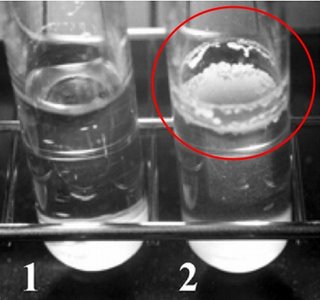
The Spanish group found that flor version of the FLO11 gene, when placed in a non-floating yeast strain, gave that yeast strain the ability to float. They also found that if they deleted FLO11 from the flor strain, that strain could no longer float. Here is a picture of a non-floating and a floating strain (circled in red):
Interestingly the FLO11 gene has one of the longest promoters, or control regions, of any yeast gene. A gene's promoter lies upstream of the gene itself, and this is where various proteins attach themselves to the DNA and regulate how much the gene gets expressed. In the case of FLO11, the long promoter means that this gene is regulated by many different signals, each one leading to some combination of proteins that sit on the DNA and regulate how much Flo11 is made.
The researchers in Seville found that if you took the flor version of just the promoter and put it in front of the FLO11 gene in a non-floating strain, that strain could then float. It turns out that the flor version of the promoter really cranks up the expression of the FLO11 gene, and this alone can confer some ability to float. The flor version of the promoter is missing one of the "off switches" found in the non-floating version - this could explain why the FLO11 gene gets cranked on so much.
That's not all there is to the story. There are also differences in the FLO11 gene itself - certain regions have expanded, allowing the final protein to be more heavily coated in sugar chains. This change in the gene alone can't confer the ability to float, but when combined with the flor version of the promoter, it produces a better floating ability than just the flor promoter alone. Flor yeasts produce more Flo11 protein, and the Flo11 they make has more sugar chains attached. This changes the surface properties of the cell and enables it to float. (In the figure below, each colored box represents a stretch of DNA.)

So what's the evolutionary story here? Inside a barrel of sherry, life is hard for yeast. Alcohol levels are high (after fermentation, sherry is fortified with brandy to about 15% alcohol), and available fermentable sugar is low. A good place to be is on top of the liquid, where yeast have more access to oxygen and can thus more efficiently metabolize what sugars are available. A few hundred years ago, a yeast in a non-floating strain lost one of its "off switches" in its FLO11 promoter through a random mutational event. (The molecular details of how such a random deletion event can occur are fairly well known.) That random mutation alone was enough to allow this yeast to float to the surface, where it was able to reproduce much better than its non-floating relatives. Subsequent changes in the FLO11 gene improved on this ability to float. This type of evolutionary scenario is probably typical of much of the adaptive evolution that occurs among mircoorganisms. Over millions and billions of years of mutation and selection in changing environments, this adds up to a lot of evolutionary change.

(Look here for a neat little movie illustrating this phenomenon.) A fun paper published in the Proceedings of the National Academy of Sciences identifies the specific genetic changes that occurred when this feature of flor yeasts evolved. It's a fun paper because it's conceptually simple, it uses only basic techniques of molecular genetics, and it reports a nice illustration of how simple molecular changes can drive adaptive evolution. Simple changes like these most likely drive much adaptation and specialization of microorganisms.
How did flor yeasts gain the ability to float? Researchers from Seville, Spain, found that this ability is due primarily to changes in a single gene, called FLO11. FLO11 produces a protein that is anchored to the outside of the yeast cell. This protein is heavily glycosylated, that is, covered with various sugar chains, and it affects the physical characteristics of the cell surface. Yeast cells regulate the production of Flo11 proteins in response to different nutrient environments, and thereby enter different growth modes that allow the yeast to make the best of the current environment. The Flo11 protein is similar to human proteins called mucins - these mucins seem to play a role in the ability of cancer cells to invade other tissues, essentially enabling cancer cells to adapt to changing nutrient conditions in their environment, much like yeast.
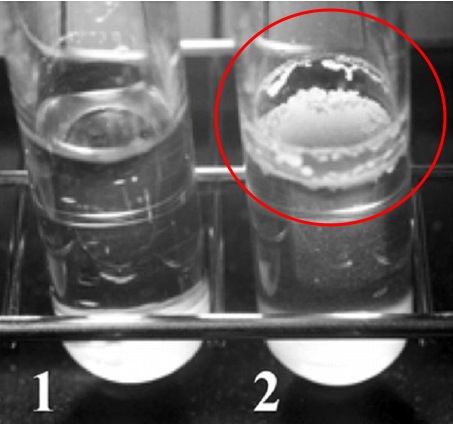
The Spanish group found that flor version of the FLO11 gene, when placed in a non-floating yeast strain, gave that yeast strain the ability to float. They also found that if they deleted FLO11 from the flor strain, that strain could no longer float. Here is a picture of a non-floating and a floating strain (circled in red):
Interestingly the FLO11 gene has one of the longest promoters, or control regions, of any yeast gene. A gene's promoter lies upstream of the gene itself, and this is where various proteins attach themselves to the DNA and regulate how much the gene gets expressed. In the case of FLO11, the long promoter means that this gene is regulated by many different signals, each one leading to some combination of proteins that sit on the DNA and regulate how much Flo11 is made.
The researchers in Seville found that if you took the flor version of just the promoter and put it in front of the FLO11 gene in a non-floating strain, that strain could then float. It turns out that the flor version of the promoter really cranks up the expression of the FLO11 gene, and this alone can confer some ability to float. The flor version of the promoter is missing one of the "off switches" found in the non-floating version - this could explain why the FLO11 gene gets cranked on so much.
That's not all there is to the story. There are also differences in the FLO11 gene itself - certain regions have expanded, allowing the final protein to be more heavily coated in sugar chains. This change in the gene alone can't confer the ability to float, but when combined with the flor version of the promoter, it produces a better floating ability than just the flor promoter alone. Flor yeasts produce more Flo11 protein, and the Flo11 they make has more sugar chains attached. This changes the surface properties of the cell and enables it to float. (In the figure below, each colored box represents a stretch of DNA.)

So what's the evolutionary story here? Inside a barrel of sherry, life is hard for yeast. Alcohol levels are high (after fermentation, sherry is fortified with brandy to about 15% alcohol), and available fermentable sugar is low. A good place to be is on top of the liquid, where yeast have more access to oxygen and can thus more efficiently metabolize what sugars are available. A few hundred years ago, a yeast in a non-floating strain lost one of its "off switches" in its FLO11 promoter through a random mutational event. (The molecular details of how such a random deletion event can occur are fairly well known.) That random mutation alone was enough to allow this yeast to float to the surface, where it was able to reproduce much better than its non-floating relatives. Subsequent changes in the FLO11 gene improved on this ability to float. This type of evolutionary scenario is probably typical of much of the adaptive evolution that occurs among mircoorganisms. Over millions and billions of years of mutation and selection in changing environments, this adds up to a lot of evolutionary change.
Tuesday, August 08, 2006
Science and the Ethics of Stem Cells
Last month Bush issued his very first veto, blocking a bill that would have allowed more federal funding for stem cell research. Roughly a week later, I heard Bush's science advisor, John Marburger, explain to an audience of molecular biologists that the president viewed this as an ethical issue, not a technical, scientific issue. No matter how much this harms research progress, in Bush's view the ethical barrier is too high to allow it. (I generally agree with the claim that this is an ethical, not a technical issue - as long as people don't use false claims about adult stem cells to justify their position; then it does become an issue about the science and not about ethics.)
Standing next to Bush were families that had 'adopted' frozen embryos from in vitro fertilization (IVF) clinics, embryos that were now the smiling children in the photo op. This setup up reinforced what I think is an extreme ethical view, a view that Bush was trying to convey at this event: that frozen embryos comprised of a handful of cells are morally equivalent to the breathing, smiling children in the photo op. Killing an embryo is no more acceptable than killing one of those children.
This position is absurd. If it is true, than I have been complicit in murder, because my wife and I have gone through two rounds of IVF.
Most people don't really know how IVF is practiced - there is a misconception that left over embryos are generally frozen, and that thus there are a lot of embryos that could be saved for, say, embryo adoption. In fact, in most IVF cycles, embryos that are not immediately used are discarded. They are only frozen if the couple wants to save some for future use, and then you have to pay to have the embryos stored for you. There are a lot of frozen embryos out there, but even more are discarded every day.
We didn't choose to freeze embryos. In our first round of IVF, we used only one, and thus several others were discarded. In our second round, we had three embryos implanted, and others were discarded. Of those three that we used, two worked.
How can anyone think that the death of one of these:
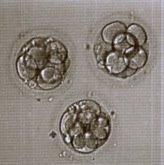
Is morally equivalent to the death of one of these:

(In case you can't see the obvious resemblance, yes, two of those three embryos in that picture eventually became our twins.)
By Bush's moral reasoning, we ended a lot of human lives to get our two dear girls. (Actually, we have three - the twins have an older sister, who was not conceived through IVF.) I haven't shed tear over the lost embryos. What human being really would? When it comes to the lives of our twins, obviously I feel much, much differently. Anyone who argues that their lives are equal to those of the lost embryos is just chasing abstractions, engaging in abstract moral reasoning that is completely severed from real human experience.
Part II: Is stem cell research really that important?
As a father of girls conceived through IVF, I think Bush's moral reasoning is absurd. As a biologist, I know there are strong scientific reasons for studying stem cells. Most of the scientific reasons the public hears about are reasons relating to relatively short term medical cures. I'm going to talk about the more fundamental scientific reasons. I think it is this fundamental science that will lead to the truly spectacular cures of the future.
The cloned sheep Dolly demonstrated a remarkable biological phenomenon. We can take the genome of an adult differentiated cell - a cell that ceased dividing, and that has shut off a huge proportion of its genes, ones not required for the specialized function of that adult cell - and we can get that genome reprogrammed so that it can direct the formation of any type of cell in the animal. The big problem is that we have no idea how this happens. We don't know the molecular details - what proteins are involved, what genes get turned on and off, and in what order this occurs.
Understanding this process would have a huge impact on biology - from the cell division cycle (related to our ability to prevent and treat cancer) to development (getting from an embryo to an adult organism). It's hard to imagine a disease whose treatment would not be affected by a thorough understanding of this process.
To understand the molecular details of genome reprogramming, we have to study embryonic stem cells. (While these cells themselves aren't being reprogrammed in the way the cell that gave rise to Dolly was, they are good tools for studying the molecular pathways that are likely involved.) Much of the basic research can currently be done in rat or mouse embryonic stem cells, but we'll need to use human cell lines as well. The experiments to study the molecular details of reprogramming are hard enough with the right resources. Limiting those resources, as Bush has done, makes this research that much harder, at least in the US.
Scientists somewhere are going to figure out genome reprogramming, and the results will overhaul our ability to treat many currently intractable diseases. Dubious ethical reasoning may ensure that those scientists won't be working in the US.
For more: Check out this lab which works on adult stem cells. The research description at the bottom of the page discusses some of the promise of stem cell research.
Standing next to Bush were families that had 'adopted' frozen embryos from in vitro fertilization (IVF) clinics, embryos that were now the smiling children in the photo op. This setup up reinforced what I think is an extreme ethical view, a view that Bush was trying to convey at this event: that frozen embryos comprised of a handful of cells are morally equivalent to the breathing, smiling children in the photo op. Killing an embryo is no more acceptable than killing one of those children.
This position is absurd. If it is true, than I have been complicit in murder, because my wife and I have gone through two rounds of IVF.
Most people don't really know how IVF is practiced - there is a misconception that left over embryos are generally frozen, and that thus there are a lot of embryos that could be saved for, say, embryo adoption. In fact, in most IVF cycles, embryos that are not immediately used are discarded. They are only frozen if the couple wants to save some for future use, and then you have to pay to have the embryos stored for you. There are a lot of frozen embryos out there, but even more are discarded every day.
We didn't choose to freeze embryos. In our first round of IVF, we used only one, and thus several others were discarded. In our second round, we had three embryos implanted, and others were discarded. Of those three that we used, two worked.
How can anyone think that the death of one of these:
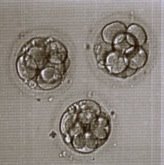
Is morally equivalent to the death of one of these:
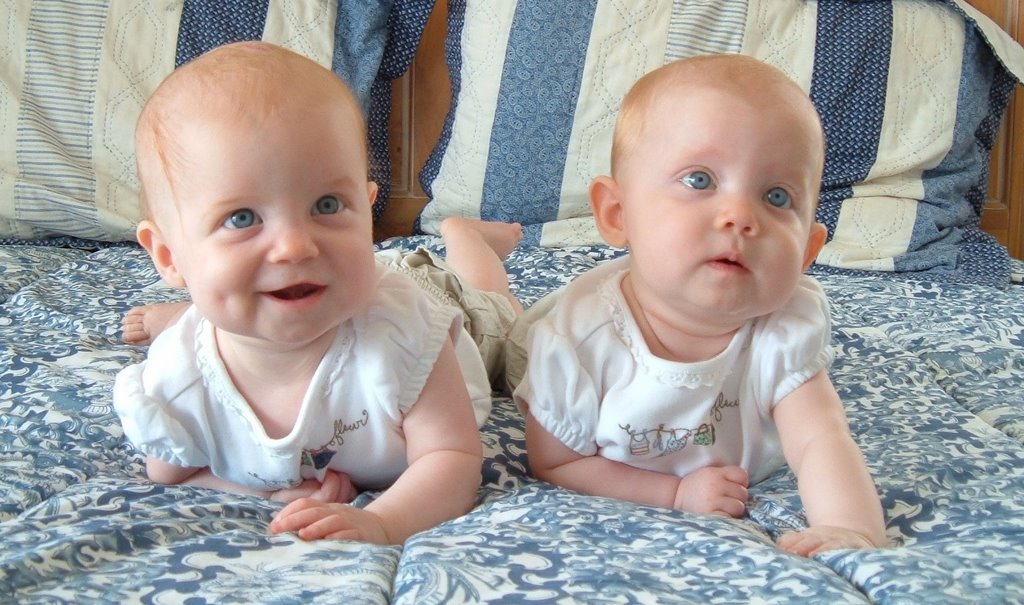
(In case you can't see the obvious resemblance, yes, two of those three embryos in that picture eventually became our twins.)
By Bush's moral reasoning, we ended a lot of human lives to get our two dear girls. (Actually, we have three - the twins have an older sister, who was not conceived through IVF.) I haven't shed tear over the lost embryos. What human being really would? When it comes to the lives of our twins, obviously I feel much, much differently. Anyone who argues that their lives are equal to those of the lost embryos is just chasing abstractions, engaging in abstract moral reasoning that is completely severed from real human experience.
Part II: Is stem cell research really that important?
As a father of girls conceived through IVF, I think Bush's moral reasoning is absurd. As a biologist, I know there are strong scientific reasons for studying stem cells. Most of the scientific reasons the public hears about are reasons relating to relatively short term medical cures. I'm going to talk about the more fundamental scientific reasons. I think it is this fundamental science that will lead to the truly spectacular cures of the future.
The cloned sheep Dolly demonstrated a remarkable biological phenomenon. We can take the genome of an adult differentiated cell - a cell that ceased dividing, and that has shut off a huge proportion of its genes, ones not required for the specialized function of that adult cell - and we can get that genome reprogrammed so that it can direct the formation of any type of cell in the animal. The big problem is that we have no idea how this happens. We don't know the molecular details - what proteins are involved, what genes get turned on and off, and in what order this occurs.
Understanding this process would have a huge impact on biology - from the cell division cycle (related to our ability to prevent and treat cancer) to development (getting from an embryo to an adult organism). It's hard to imagine a disease whose treatment would not be affected by a thorough understanding of this process.
To understand the molecular details of genome reprogramming, we have to study embryonic stem cells. (While these cells themselves aren't being reprogrammed in the way the cell that gave rise to Dolly was, they are good tools for studying the molecular pathways that are likely involved.) Much of the basic research can currently be done in rat or mouse embryonic stem cells, but we'll need to use human cell lines as well. The experiments to study the molecular details of reprogramming are hard enough with the right resources. Limiting those resources, as Bush has done, makes this research that much harder, at least in the US.
Scientists somewhere are going to figure out genome reprogramming, and the results will overhaul our ability to treat many currently intractable diseases. Dubious ethical reasoning may ensure that those scientists won't be working in the US.
For more: Check out this lab which works on adult stem cells. The research description at the bottom of the page discusses some of the promise of stem cell research.
Tuesday, August 01, 2006
Keynote speech by Bush's Science Advisor
I just got back from the Yeast Genetics and Molecular Biology Meeting. To someone who's not a biologist, this might seem like an obscure topic - akin to a meeting on tree frogs or the infamous spotted owl. Such an impression would be wrong though - this is a major conference focused on fundamental research in molecular cell biology. Many of the major players in the field of genomics attend this meeting, and most of the research presented is relevant to human biology.
One of the keynote speakers this year was Dr. John Marburger, science advisor to President Bush and director of the Office of Science and Technology Policy. (There is some interesting stuff on this website, although it's juxtaposed with White House propaganda.) I was really wondering what Marburger was going to say - the biologists attending this meeting are generally not big fans of the current President, especially the Europeans.
Marburger actually gave a nice talk - he spoke of his serious committment to basic science (as opposed to applied science). He emphasized that US policy needs to be sure not to squeeze out the basic research that is ultimately necessary for the applied science we all appreciate, like disease cures, fuel cells, better power plants, and better computers. Marburger also said that basic research is not only justified by what goes into the applied science pipeline, but that it is also (to quote Oppenheimer) ennoblng to scientists and society.
All the excitement was in the Q&A session. Most of the questions were reasonable but some were excessively inflammatory - people could have asked the same question in a more serious and hard-hitting way. No surprise though, given the nature of the audience. But Marburger basically rose to the bait. Not only did he defend Bush (which is after all part of his job), but he also piled on the superlatives. He said Bush has been more supportive of science than any other president, he said that Bush never uses hot-button issues to create divisiveness (hello? South Carolina primary in 2000? Support for amendments to ban gay marriage every election year?), that Bush is one of the most principled men he knows, and that Bush is really, really personally interested in basic science. When someone raised the issue of Bush's offhand endorsement of intelligent design, Marbugrer dismissed as a flustered response to a "gotcha question." Gotcha question? A reporter calls out a question about an issue that has been in the headlines for months, a question which Bush could have easily ignored (and then it wouldn't have made the news), and Marburger calls it entrapment? And then Marburger claimed that Bush didn't actually mean what he said.
Bullshit. Marburger may be a distinguished scientists and administrator, but in this setting he came off as a Bush stooge. All he had to do was defend the worst accusations against Bush, but he went beyond it and tried to portray Bush as somebody the man most definitely isn't. He may not be the worst thing that ever happened to science, but he's certainly not the most supportive president in history. Marburger lost whatever crediblity he may have had with this group.
One more point needs to be emphasized. The Bush administration is not one man. Just because Bush hasn't had a direct hand in some science controversy, his administration is certainly populated with people who are ideologically motivated to smear and suppress serious science. Marburger focused a lot on Bush himself (with a typical Bush-like emphasis on a person's charcter rather than actions) and completely ignored the criticisms leveled against the administration as a whole.
One of the keynote speakers this year was Dr. John Marburger, science advisor to President Bush and director of the Office of Science and Technology Policy. (There is some interesting stuff on this website, although it's juxtaposed with White House propaganda.) I was really wondering what Marburger was going to say - the biologists attending this meeting are generally not big fans of the current President, especially the Europeans.
Marburger actually gave a nice talk - he spoke of his serious committment to basic science (as opposed to applied science). He emphasized that US policy needs to be sure not to squeeze out the basic research that is ultimately necessary for the applied science we all appreciate, like disease cures, fuel cells, better power plants, and better computers. Marburger also said that basic research is not only justified by what goes into the applied science pipeline, but that it is also (to quote Oppenheimer) ennoblng to scientists and society.
All the excitement was in the Q&A session. Most of the questions were reasonable but some were excessively inflammatory - people could have asked the same question in a more serious and hard-hitting way. No surprise though, given the nature of the audience. But Marburger basically rose to the bait. Not only did he defend Bush (which is after all part of his job), but he also piled on the superlatives. He said Bush has been more supportive of science than any other president, he said that Bush never uses hot-button issues to create divisiveness (hello? South Carolina primary in 2000? Support for amendments to ban gay marriage every election year?), that Bush is one of the most principled men he knows, and that Bush is really, really personally interested in basic science. When someone raised the issue of Bush's offhand endorsement of intelligent design, Marbugrer dismissed as a flustered response to a "gotcha question." Gotcha question? A reporter calls out a question about an issue that has been in the headlines for months, a question which Bush could have easily ignored (and then it wouldn't have made the news), and Marburger calls it entrapment? And then Marburger claimed that Bush didn't actually mean what he said.
Bullshit. Marburger may be a distinguished scientists and administrator, but in this setting he came off as a Bush stooge. All he had to do was defend the worst accusations against Bush, but he went beyond it and tried to portray Bush as somebody the man most definitely isn't. He may not be the worst thing that ever happened to science, but he's certainly not the most supportive president in history. Marburger lost whatever crediblity he may have had with this group.
One more point needs to be emphasized. The Bush administration is not one man. Just because Bush hasn't had a direct hand in some science controversy, his administration is certainly populated with people who are ideologically motivated to smear and suppress serious science. Marburger focused a lot on Bush himself (with a typical Bush-like emphasis on a person's charcter rather than actions) and completely ignored the criticisms leveled against the administration as a whole.
Subscribe to:
Posts (Atom)


