
Around my neighborhood here in St. Louis you can find a lot of lawn signs dealing with "Amendment 2" - a stem cell research and therapies amendment which will be on the ballot next month.
As a general principle, I think the public (the taxpayers funding scientific research in the US) should be involved discussing what kind of science should be done in our society. Mind you, they shouldn't be judging the scientific, technical merit of specific proposals - that's as absurd as asking someone with no engineering training to evaluate the structural integrity of a proposed bridge design.
But some general input is good. I just submitted a funding proposal to the American Cancer Society. On their review panels, they include non-scientists who are interested in cancer research, and my application includes an explanation in non-technical language of what I'm proposing to do and how it is related to cancer. I am judged partly on how well I can explain my work to a general audience, and, more importantly, on whether I can persuade the non-scientist on the panel that my work is important for cancer research. I think that's a great part of the process.
On the other hand, often in the political arena, people's arguments on science issues are based on pure dishonesty and bad faith. The opposition movement to Missouri's amendment 2 falls under this category; they are lying to scare people into voting against the amendment. In their flyers and on their website, they lecture us about ethics, but they are liars and deserve no credibility on this issue.
These are harsh words, but as you'll see below, almost every reason they give to vote against this bill is either deliberately misleading or based on a flat-out lie.
To see that these people are liars, you have to know first what the amendment says. It's never a good idea to take someone else's word on what a ballot initiative says, so you read it yourself right here. And if you're not a resident of Missouri, you should still be interested, because many other states are wrestling with the same issue right now, not to mention our national debate on the subject.
Here's my summary of what I think is a very reasonable initiative (and really, check me by reading the initiative yourself):
The Main Point: stem cell research and therapies permitted under federal law shall be legal in Missouri. Since very little is actually legal or funded under current federal law (and this amendment isn't providing any money), right now this makes little difference. This amendment is really aimed at a time when, say, Congress could override a Bush veto of a stem cell bill like the one that was recently vetoed. This amendment is just assuring that stem cell research and therapies are treated like any other research. You don't generally see certain mainstream research or therapies banned in certain states, while permitted overall at the federal level.
Important restrictions specified in the amendment:
- no cloning a human being - that is, you can't implant a human embryo in a human uterus, if that embryo was not created with human sperm and egg. A cloned embryo is created without sperm (referred to below as Somatic Cell Nuclear Transfer or SCNT).
- no creating a blastocyst purely for research by fertilization - in other words, embryos taken for stem cells would be left over at in vitro fertilization (IVF) clinics, or created through producing a clone by SCNT (if permitted by federal law).
-no taking cells from a blastocyst after more than 14 days of cell division
-no selling eggs or blastocysts
The amendment also includes typical provisions that already apply to all ongoing research using human subjects or samples; these provisions are redundant, because they are already required by current federal laws and regulations:
- donors of eggs/blastocysts must give informed, voluntary consent
- researchers must comply with normal standards of bioethics, must have Institutional Review Board approval (required at all research universities before someone can work with human subjects or tissue samples), and comply with all other regulations that apply to research with human subjects and samples in general.
This proposal basically deals with all non-fundamentalist ethical issues, and I predict that such an approach will be adopted at the federal level within 4 years (and maybe even during the next Congressional session).
A side note on cloning: Beware of people who try to tell you cloning is cloning is cloning - and that there is no difference, it's all ethically the same. Not true! Scientists use the term cloning to mean different things. Cloning a gene is not the same a cloning a human being. Molecular biologists make copies of genes and put them into a variety of different contexts; they call that cloning. Making a human clone involves implanting a cloned embryo into a uterus, and having the woman eventually deliver the baby. This has not been done yet, and it's unethical because you would probably have hundreds of women suffer hundreds of miscarriages before you actually had a live birth. On top of that, that live child will probably have future health problems (because that's what we've observed in cloned animals). But these human clones would not be soulless robots (the Hollywood-inspired fear expressed by a woman I met on the train the other month) - they would be like the natural clones among us today - identical twins, fully autonomous human beings.
Cloning embryos for stem cell research starts out the same as human cloning (pull the DNA from an egg, put in DNA from an adult cell, and get it to divide without fertilization by sperm - SCNT), but you don't implant the embryo in a uterus. People worry that doing this though is the first step towards human cloning, and what's to stop us from going all the way? Well, the fact that cloning an embryo is the easy part, getting it to develop in the uterus is the really hard part. And also, the ethical issues significantly change once you implant such an embryo in the uterus, as I stated before.
Back to amendment 2: the proposed amendment is facing a disinformation campaign by a dishonest opposition. The "Missourians Against Human Cloning" have put out 20 talking points, each of which is either severely misleading or an outright lie. If you've had enough of this issue, you can stop reading the post here, but for all the gory details, keep reading:
- "Reason 1: Amendment 2 would permanently change Missouri's Constitution." Permanently, until voters adopt an amendment to change this one. This claim is misleading, because it ignores that fact that, unlike what happens at the federal level, state constitutional amendments are a common way of doing business in most states, and the amendments are easy to change. Missouri has four proposed amendments on the ballot this Fall, most dealing with mundane issues like property tax exemptions and pensions for state officials convicted of felonies. There is nothing unusual about putting an issue like stem cell research into a state constitutional amendment.
- "Reason 2: Amendment 2 will use our tax dollars for unethical and unproven research. Despite claims to the contrary, if Amendment 2 passes, Missourians will pay for unethical and unproven research indefinitely." Also dishonest - the amendment provides NO MONEY. Any money for such research would come from the NIH budget, which is unlikely to get an extra raise specifically for stem cell research. If you want to talk about our tax dollars going to something unethical (and, of unproven or disproven effectiveness), let's talk about the Bush administration's torture policy.
- "Reason 3: Amendment 2 would create a constitutional right to devalue human life - it would treat human life as a commodity and raw material for unethical human experimentation by the bio-tech industry." Here's an outright lie - the amendment specifically prohibits treating eggs or embryos as commodities - that is, something to be bought and sold. Beyond that, the claim that stem cell research for disease cures in some vague, unarticulated way devalues human life is weak. Notice the scare language that implicitly evokes Nazi-style research - stem cell research is 'unethical human experimentation'!
- "Reason 4 - Amendment 2 is harmful to women... up to 35% of women who submit to ovarian stimulation experience health consequences, and up to 14% of these are severe." Those numbers are false. The procedure is uncomfortable, but it's not really more risky than an appendectomy. It's done routinely, every day, all over this country. My wife went through many rounds of ovarian stimulation drugs, and went through egg retrieval twice. These drugs have been used for a long time, they have a long track record, and they are safe in the vast majority of cases (no riskier than the anesthesia used in a routine appendectomy). It's extremely common, and I would be money that you know someone who has taken ovarian stimulation drugs, even though you may not be aware of it.
- "Reason 5 - Amendment 2 is unnecessary - adult stem cell research has been proven effective for many illnesses... We need to retain the option to direct our tax dollars to this ethical and promising research." That's false - there are actually few illnesses that adult stem cells work for - anything requiring a bone marrow transplant, and that's just about it. We always have the option to study adult stem cells, and labs who are already doing this work are not suddenly going to drop it once there is money for embryonic stem cell research. Furthermore, the adult stem cell researchers I know personally are some of the most passionate advocates for embryonic stem cell research, even though they have no intention of dropping all of their current work to study embryonic stem cells should funding become available.
- "Reason 6: Amendment 2 protects and promotes human cloning. The proponents want you to believe that Somatic Cell Nuclear Transfer (SCNT) is NOT cloning, but the reality is that every textbook and scientific journal defines SCNT as Cloning." Here they dishonestly try to muddy the waters by exploiting the fact that scientists use the term cloning in different ways - see my earlier note on cloning. The ethical issues relevant to making a live human clone are different from those involving cloning embryos (or SCNT) that will never see the inside of a uterus. You have to articulate each of these ethical cases individually. I can think of reasons why it's wrong to make human clones (health problems in the cloned humans, emotional and physical risks to the women who carry these pregnancies with a high risk of failure), but those reasons don't apply to embryos that are never implanted in a uterus. The Amendment 2 opponents are think they can just get away with screaming CLONING!!! instead of articulating a serious argument against embryo cloning. This is a tactic that repeatedly shows up in this debate.
- "Reason 7 Amendment 2 is an elite initiative" - basically, 95% of the promotional money for this amendment came from one wealthy couple. This talking point is not dishonest, it's just stupid. We'll see how elite this amendment really is when we vote on it next month.
- "Reason 8 - Amendment 2 is immoral. It is ethically wrong to destroy human life regardless of its origin or geography." I'm not sure what geography has to do with anything here, but if Amendment 2 is immoral because it 'destroys human life', then so is the process used for in vitro fertilization and many common forms of birth control. Most citizens don't seem to be outraged over birth control or IVF, so I take it that most people don't buy this ethical reasoning.
- "Reason 9 - Amendment 2 will exploit the disadvantaged" because they will be paid to donate their eggs for research. In reality, this won't exploit the 'disadvantaged' any more than any other research involving human subjects - people who volunteer for such studies are paid a small fee in return for their time, effort, and travel expenses. This is how all new drugs and treatments are tested - if amendment 2 is exploitative, so is essentially all research with human subjects. Many such studies involve procedures much more risky than egg donation.
- "Reason 10: Amendment 2 is wrong. To permanently change our constitution to protect unproven and risky scientific experimentation is wrong." We're only halfway to Reason 20, and already they're recycling their previous reasons (see Reasons 1, 2, and 5). I guess this means that there really aren't 20 independent reasons to vote against Amendment 2.
- "Reason 11: Amendment 2 ignores proven research. Ethical stem cell research provides real hope without cloning or destroying human life..." Now they're recycling Reason 5.
- "Reason 12: Amendment 2 is deceptive - it will PROMOTE not ban human cloning." Recycling Reason 6 here. Like I said above, this is a dishonest and misleading attempt to muddy the various meanings of 'cloning'. Amendment 2 bans cloning human beings, but it does not ban the creation of cloned human embryos that will never be implanted in a uterus. Amendment 2 is clear about it's definitions (again, go read the entire thing yourself); the Missourians Against Human Cloning are the ones being deceptive.
- "Reason 13: Amendment 2 will destroy human life." Amendment 2 could save human lives through the treatments it might facilitate. Unless you think destroying blastocysts is equal to murder, Reason 13 is not true.
- "Reason 14: Amendment 2 will NOT give Missourians more access rights to cures or therapies that they and every other American ALREADY enjoy." This is dishonest - that's not the point of the amendment; the point is to make sure that future therapies permitted elsewhere aren't banned in Missouri.
- "Reason 15: Amendment 2 ignores the success of Adult Stem Cell therapies and cures." Wow, we're recycling Reason 5 for a second time. Amendment 2 does not 'ignore' Adult stem cell research - it doesn't ban it and it doesn't take away research dollars (especially since it doesn't provide any research dollars for embryonic stem cell research). And naturally adult stem cells therapies are farther along than embryonic stem cell therapies - adult stem cell research has been going on longer, and that research hasn't been blocked at the federal level.
- "Reason 16: Amendment 2 will NOT insure First Class status to Missouri's biotech industry." This is, amazingly enough, largely true. There is no generic 'First Class status' - different communities excel in different areas of biotech. Missouri can excel in other areas without being #1 in stem cell research.
- "Reason 17: Amendment 2 is NOT in step with the rest of the world." They go on to say that 27 countries have banned human cloning. But again, they are dishonestly exploiting the multiple definitions of cloning. Some of those countries have passed legislation essentially identical to Amendment 2, which does ban cloning full human beings but allows other research. To use those countries as an argument against amendment 2 is extremely dishonest.
- "Reason 18: Amendment 2 will require your hard earned tax dollars." Recycling again - go back and look at Reason 2. They go on to claim that "private money has been directed to more promising research avenues," which is an outright lie - private money is almost the only source of money currently available for stem cell research in this country. It would be helpful if federally funded labs (meaning, most university research labs) could be involved in stem cell research.
- "Reason 19: Amendment 2 has potential to make some people and corporations very wealthy at Missourians' expense. Researchers and bio-tech corporations stand to make a lot of money from patents - even if no cures ever come from human cloning and embryonic stem cell research." In a sense this is true of all government sponsored research - taxpayers fund research at academic labs, which is then developed into usable drugs and therapies by corporations who earn a profit. The whole thing about patent wealth even if there are no cures - this is a little crazy. Honestly, how many people get wealthy from patents on technologies that don't work?
- "Reason 20: Amendment 2 contains no real internal controls or oversight." Another lie. The internal controls and oversight specified in Amendment 2 are exactly the same as those required for any other research involving human subjects. Universities have to certify to funding agencies that they are compliant with these regulations, every time a researcher submits a grant proposal. There is nothing in Amendment 2 that makes stem cell research exempt from all of the regular oversight that is currently in place for studies like vaccine trials, drug tests, experimental surgeries, etc. Reason 20 does not offer an argument specific to stem cell research.
These talking points are largely based on fear-mongering, dishonest blurring of definitions of cloning, and base appeals against 'elites', the wealthy, and the biotech industry. If you live in Missouri, you should be embarrassed to have a 'Vote NO on Amendment 2' lawn sign (at least ones issued by Missourians Against Human Cloning). If you're not in Missouri, I'm sure you'll see nearly identical arguments at some point in your own state, or if not, again at the federal level once the next Congress is in session.
Sunday, October 15, 2006


Tuesday, October 03, 2006
Nobel week kicks off with a well-deserved award for RNAi
It's Nobel week, and I'm enough of a nerd to anxiously look forward to this week every year. Yesterday the Nobel committee annouced that the Medicine/Physiology prize is going to Andrew Fire and Craig Mello. Fire is currently at Stanford, and Mello is at U. Mass in Worcester.
It's great to see the prize go to scientists who are under 50, recognizing work that was done less than a decade ago. When the prize recognizes very old work too often, the Nobel loses much of its excitement and risks losing its relevance to current science. The original Nature paper by Fire, Mello, and their colleagues, came out in Feb. 1998. Since that time, RNAi has become huge in the field of biology - both in terms of its role in the cell, as a powerful genetics tool, and as a potential way to do gene therapy.
RNAi, or RNA interference, is when the expression of a single gene is shut off by the presence of foreign RNA molecules that match part of the sequence of that gene. RNAi occurs in plants, animals, and fungi, and most likely evolved as a defense against viruses and other genomic parasites (such as transposons - they're like viruses that spread through the genome and never leave the cell; we all have a lot of these parasites hanging around in our genomes).
What did Fire and Mello do? A look at their work illustrates how major scientific discoveries don't just come out of thin air - they are based on the groundwork usually laid down by several different research groups. Fire and Mello didn't discover RNAi - scientists had known for years that injecting small RNA molecules into organisms like round worms (such as C. elegans - the organism Fire and Mello work with) could inhibit the expression of single genes. Similar phenomena had been described for both plants and bread mold. (Bread mold - N. crassa - is another weird organism that has been used to study many basic cellular processes.)
People hypothesized that it worked because injected 'anti-sense' RNA bound (or 'hybridized') to the cell's messenger RNA (mRNA) and prevented that mRNA from serving as a template for synthesizing new protein:
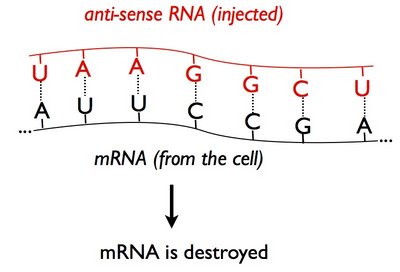
(Recall that the letters A,C,G, and in RNA, U stand for chemical groups that match up with each other - A pairs with U, C pairs with G.)
But there were problems with this idea - it also worked with 'sense' RNA as well, which would not bind to the mRNA molecule. Also, a small number of injected RNA molecules, not nearly enough to bind up all of the mRNA produced by a partuclar gene, could cause RNAi - suggesting that the injected RNA molecules were reused over and over to break down the mRNA (that is, they funtioned catalytically). This effect could even been seen in the next generation of organisms, that had not been injected with foreign RNA.
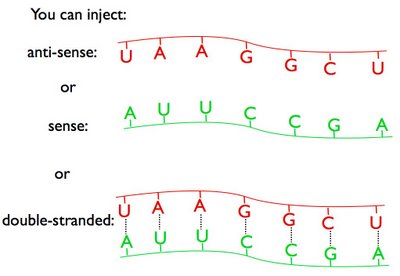
Fire, Mello and colleagues came up with the brilliant idea that the phenomenon might be caused by double-stranded RNA molecules, which would have been present as contaminants in any injected sample of RNA. Such double-stranded molecules would not work by simply hybridizing to the mRNA (as shown in the figure above). The process would have to work by some other mechanism, which at the time was completely unknown.
So Fire and Mello deliberately prepared sense, anti-sense, and double-stranded RNAs, injected them into worms, and looked to see which RNA molecules would be most effective at knocking down gene expression.
They picked a clever target gene to knock down - unc-22, a gene coding for a muscle protein. When that muscle protein is absent, the worms uncontrollably twitch. So Fire and Mello injected the different RNA molecules into worm embryos, and looked to see which ones resulted in twitching adult worms, indicating that the unc-22 gene had been shut off. Their results conclusively demonstrated that it was the double-stranded RNA molecules, not the individual sense or anti-sense molecules, that caused RNAi.
This paved the way for later discoveries figuring out excatly how this process works, and for making huge collections of these RNAs that can be used to knock down just about any gene you want in model organisms like flies and worms. Until RNAi, you couldn't shut off genes so easily, except in microorganisms like yeast (which is one reason why yeast is so useful for studying basic molecular biology). Now, you can do those things in multi-cellular organisms, and hardly a week goes by without the report of some new discovery made using RNAi. These double-stranded RNA molecules are even being tested as drugs in humans, to shut off aberrant genes in people with certain diseases. This was certainly a timely and well-deserved Nobel prize.
It's great to see the prize go to scientists who are under 50, recognizing work that was done less than a decade ago. When the prize recognizes very old work too often, the Nobel loses much of its excitement and risks losing its relevance to current science. The original Nature paper by Fire, Mello, and their colleagues, came out in Feb. 1998. Since that time, RNAi has become huge in the field of biology - both in terms of its role in the cell, as a powerful genetics tool, and as a potential way to do gene therapy.
RNAi, or RNA interference, is when the expression of a single gene is shut off by the presence of foreign RNA molecules that match part of the sequence of that gene. RNAi occurs in plants, animals, and fungi, and most likely evolved as a defense against viruses and other genomic parasites (such as transposons - they're like viruses that spread through the genome and never leave the cell; we all have a lot of these parasites hanging around in our genomes).
What did Fire and Mello do? A look at their work illustrates how major scientific discoveries don't just come out of thin air - they are based on the groundwork usually laid down by several different research groups. Fire and Mello didn't discover RNAi - scientists had known for years that injecting small RNA molecules into organisms like round worms (such as C. elegans - the organism Fire and Mello work with) could inhibit the expression of single genes. Similar phenomena had been described for both plants and bread mold. (Bread mold - N. crassa - is another weird organism that has been used to study many basic cellular processes.)
People hypothesized that it worked because injected 'anti-sense' RNA bound (or 'hybridized') to the cell's messenger RNA (mRNA) and prevented that mRNA from serving as a template for synthesizing new protein:

(Recall that the letters A,C,G, and in RNA, U stand for chemical groups that match up with each other - A pairs with U, C pairs with G.)
But there were problems with this idea - it also worked with 'sense' RNA as well, which would not bind to the mRNA molecule. Also, a small number of injected RNA molecules, not nearly enough to bind up all of the mRNA produced by a partuclar gene, could cause RNAi - suggesting that the injected RNA molecules were reused over and over to break down the mRNA (that is, they funtioned catalytically). This effect could even been seen in the next generation of organisms, that had not been injected with foreign RNA.
Fire, Mello and colleagues came up with the brilliant idea that the phenomenon might be caused by double-stranded RNA molecules, which would have been present as contaminants in any injected sample of RNA. Such double-stranded molecules would not work by simply hybridizing to the mRNA (as shown in the figure above). The process would have to work by some other mechanism, which at the time was completely unknown.
So Fire and Mello deliberately prepared sense, anti-sense, and double-stranded RNAs, injected them into worms, and looked to see which RNA molecules would be most effective at knocking down gene expression.
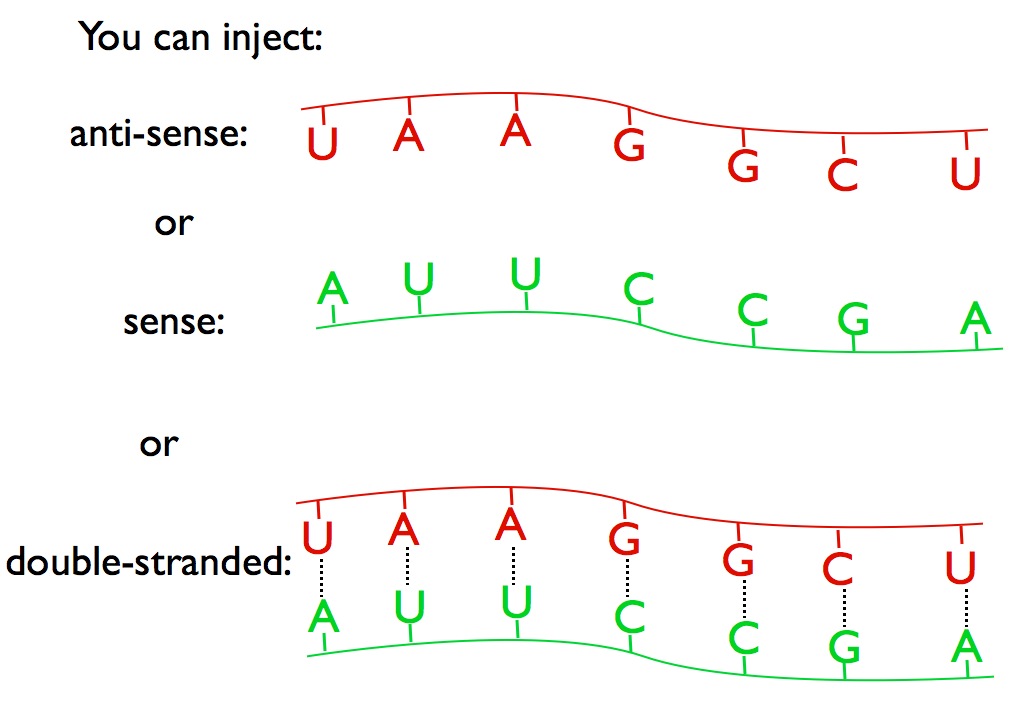
They picked a clever target gene to knock down - unc-22, a gene coding for a muscle protein. When that muscle protein is absent, the worms uncontrollably twitch. So Fire and Mello injected the different RNA molecules into worm embryos, and looked to see which ones resulted in twitching adult worms, indicating that the unc-22 gene had been shut off. Their results conclusively demonstrated that it was the double-stranded RNA molecules, not the individual sense or anti-sense molecules, that caused RNAi.
This paved the way for later discoveries figuring out excatly how this process works, and for making huge collections of these RNAs that can be used to knock down just about any gene you want in model organisms like flies and worms. Until RNAi, you couldn't shut off genes so easily, except in microorganisms like yeast (which is one reason why yeast is so useful for studying basic molecular biology). Now, you can do those things in multi-cellular organisms, and hardly a week goes by without the report of some new discovery made using RNAi. These double-stranded RNA molecules are even being tested as drugs in humans, to shut off aberrant genes in people with certain diseases. This was certainly a timely and well-deserved Nobel prize.
Tuesday, September 26, 2006
Tierney weighs in on the Gender Bias Panel
In my last post I discussed the recent National Academies panel on gender bias. In today's NY Times, John Tierney weighs in on the issue. (This one is 'Times Select' - subscription required.)
I'm usually at ideological odds with Tierney, but not quite so much this time. He comes up with a great Onion title for the panel's work:
"This is the kind of science you expect to find in The Onion: 'Academy Forms Committee to Study Gender Discrimination, Bars Men from Participating.' Actually, it did allow a total of one man, Robert Birgeneau of Berkeley, on the 18-member committee, but that was presumably because he was already on record agreeing with the report’s pre-ordained conclusion: academia must stop favoring male scientists and engineers."
Tierney hits some good points (such as how the panel fails to distinguish between bias 30 years ago and bias today). He also gets into the 'innate differences' issue that I avoided in my last post:
"One well-documented difference is the disproportionately large number of boys scoring in the top percentile of the SAT math test. And when you compare boy math whizzes with girl math whizzes, more differences appear. The boys score much higher on the math portion of the SAT than on the verbal, whereas the girls are more balanced — high on the verbal as well as the math.
The girls have more career options, and they have different priorities than the boys, as the psychologists David Lubinski and Camilla Persson Benbow have demonstrated by tracking students with the exceptional mathematical ability to become top-flight researchers in science and engineering."
I've got two things to note about this:
- In addition to a disproportionate number of boys in the top math SAT percentile, there is also a disproportionate number of boys in the bottom percentile. In other words, the average score is not so different among boys and girls, but there are more boys on both ends of the curve.
- This difference in the top percentile in SAT math may be relevant to differences in some sciences like theoretical physics or pure math (I have no idea), but, as I hinted at in my last post, I think it's irrelevant in many other fields like biology. Biology has some very quantitative aspects, but the people I know who are outstanding in those areas aren't necessarily the ones who were 'math whizzes' on the SAT. Good biologists need a variety of different skills, not just the ones that lead to a top SAT math score. Also, in biology, rigorous verbal reasoning skills play a much larger role, and recall that girls are overrepresented in the top percentiles of the verbal SAT. So are women innately better biologists?
One statement in Tierney's article especially bugs me- he lumps biology with psychology as a 'soft science.' This idea that men are better at 'hard' sciences and women are better at 'soft' sciences is just crap. Biology is just as much a hard (meaning, roughly, quantitative and experimentally rigorous) science as any other of the natural sciences - geology, astronomy, and yes, physics and chemistry. Biology (evolution, molecular biology, genetics, ecology, etc.) has much more in common with astronomy or geology than with psychology.
UPDATE: If you can access this (subscription required), this Nature Neuroscience Editorial has some interesting references to the primary literature and comments on the differences in SAT scores. They note that the score differences (more boys at the tail ends of the curve) don't occur in all Western countries, suggesting that the effect may very well be cultural. Who knows? It seems like the debate is often just stuck at the level of "Women are less able!" "No they're not, men are just hopelessly predjudiced!" As I made clear in my last post, I think there are other answers.
[This post was edited a few times for clarity.]
I'm usually at ideological odds with Tierney, but not quite so much this time. He comes up with a great Onion title for the panel's work:
"This is the kind of science you expect to find in The Onion: 'Academy Forms Committee to Study Gender Discrimination, Bars Men from Participating.' Actually, it did allow a total of one man, Robert Birgeneau of Berkeley, on the 18-member committee, but that was presumably because he was already on record agreeing with the report’s pre-ordained conclusion: academia must stop favoring male scientists and engineers."
Tierney hits some good points (such as how the panel fails to distinguish between bias 30 years ago and bias today). He also gets into the 'innate differences' issue that I avoided in my last post:
"One well-documented difference is the disproportionately large number of boys scoring in the top percentile of the SAT math test. And when you compare boy math whizzes with girl math whizzes, more differences appear. The boys score much higher on the math portion of the SAT than on the verbal, whereas the girls are more balanced — high on the verbal as well as the math.
The girls have more career options, and they have different priorities than the boys, as the psychologists David Lubinski and Camilla Persson Benbow have demonstrated by tracking students with the exceptional mathematical ability to become top-flight researchers in science and engineering."
I've got two things to note about this:
- In addition to a disproportionate number of boys in the top math SAT percentile, there is also a disproportionate number of boys in the bottom percentile. In other words, the average score is not so different among boys and girls, but there are more boys on both ends of the curve.
- This difference in the top percentile in SAT math may be relevant to differences in some sciences like theoretical physics or pure math (I have no idea), but, as I hinted at in my last post, I think it's irrelevant in many other fields like biology. Biology has some very quantitative aspects, but the people I know who are outstanding in those areas aren't necessarily the ones who were 'math whizzes' on the SAT. Good biologists need a variety of different skills, not just the ones that lead to a top SAT math score. Also, in biology, rigorous verbal reasoning skills play a much larger role, and recall that girls are overrepresented in the top percentiles of the verbal SAT. So are women innately better biologists?
One statement in Tierney's article especially bugs me- he lumps biology with psychology as a 'soft science.' This idea that men are better at 'hard' sciences and women are better at 'soft' sciences is just crap. Biology is just as much a hard (meaning, roughly, quantitative and experimentally rigorous) science as any other of the natural sciences - geology, astronomy, and yes, physics and chemistry. Biology (evolution, molecular biology, genetics, ecology, etc.) has much more in common with astronomy or geology than with psychology.
UPDATE: If you can access this (subscription required), this Nature Neuroscience Editorial has some interesting references to the primary literature and comments on the differences in SAT scores. They note that the score differences (more boys at the tail ends of the curve) don't occur in all Western countries, suggesting that the effect may very well be cultural. Who knows? It seems like the debate is often just stuck at the level of "Women are less able!" "No they're not, men are just hopelessly predjudiced!" As I made clear in my last post, I think there are other answers.
[This post was edited a few times for clarity.]
Monday, September 25, 2006
The long road to a career in academic biology...
What's a postdoc? 90% of the time, that's the next question I'm asked after people ask me what I do for a living. Or worse, people who know I spent 5 and a half years in grad school will say "wow, I can't believe you're still a student!" It's clear that most people outside the scientific community don't know what postdocs are - Students? Interns? Trainees?
People should know what postdocs are - at very least so that they don't call them students! More importantly, the public should know who is actually doing the vast majority of the experiments and fieldwork that get published in hundreds of scientific journals every week: postdoctoral fellows and grad students. They are the people who pick up the test tubes and pipettes, go the lab bench, and run the experiments. That's not to say that the professor just sits back and gets all the credit - professors are generally full intellectual participants in the research, and they're usually the ones who came up with the main idea for the research project. However, the point here is that grad students and postdocs aren't simply trainees learning their trade; they are practicing scientists who produce valuable, tangible work. Unlike undergraduate education, this is on-the-job training much like any other career field.
Postdocs are no longer students - they have their PhDs, and they're not attending classes, taking tests, or writing a thesis. If a graduate student is an apprentice, a postdoc is a journeyman - a credentialed, capable scientist who is gaining more experience under the guidance of a senior scientist. A postdoctoral position is a chance to learn some new skills and work more independently without having to jump through the administrative hoops of grad school. The research you do as a postdoc lays the foundation for what you'll do in your own lab as a professor.
I still seem like a student to my friends in other careers because my job as a postdoc is only temporary (3-5 years), and I still make well below the median US income. (Starting postdoc salaries range from $30k to ~$40k, and rise to $40-$45k after 2 years of experience.) This is why the career path of an academic scientist seems so long - you hardly earn anything and don't settle down until you're in your mid- to late 30's, even though you have a doctorate and you do demanding, highly technical work. You spend 5+ years as a grad student with a 22k annual salary, no retirement benefits, and bare-bones health insurance. Your reward for earning a PhD? A temporary job with a low salary, no retirement benefits, and if you're lucky, decent health insurance. All this, while your friends who went to law school finished their degrees years ago, got paid $50-60k during a brief clerkship, and are now raking in more money than you'll make as a tenured scientist.
On the other hand, if you work with a good mentor, you wouldn't trade this job for any other. In spite of the unsustainable pay level (you'll never retire or send your kids to college on it), as a science postdoc you get to continually drive your intellect and creativity, you get to play with fun, high-tech toys, and you have a degree of independence that almost rivals that of a freelance writer.
People should know what postdocs are - at very least so that they don't call them students! More importantly, the public should know who is actually doing the vast majority of the experiments and fieldwork that get published in hundreds of scientific journals every week: postdoctoral fellows and grad students. They are the people who pick up the test tubes and pipettes, go the lab bench, and run the experiments. That's not to say that the professor just sits back and gets all the credit - professors are generally full intellectual participants in the research, and they're usually the ones who came up with the main idea for the research project. However, the point here is that grad students and postdocs aren't simply trainees learning their trade; they are practicing scientists who produce valuable, tangible work. Unlike undergraduate education, this is on-the-job training much like any other career field.
Postdocs are no longer students - they have their PhDs, and they're not attending classes, taking tests, or writing a thesis. If a graduate student is an apprentice, a postdoc is a journeyman - a credentialed, capable scientist who is gaining more experience under the guidance of a senior scientist. A postdoctoral position is a chance to learn some new skills and work more independently without having to jump through the administrative hoops of grad school. The research you do as a postdoc lays the foundation for what you'll do in your own lab as a professor.
I still seem like a student to my friends in other careers because my job as a postdoc is only temporary (3-5 years), and I still make well below the median US income. (Starting postdoc salaries range from $30k to ~$40k, and rise to $40-$45k after 2 years of experience.) This is why the career path of an academic scientist seems so long - you hardly earn anything and don't settle down until you're in your mid- to late 30's, even though you have a doctorate and you do demanding, highly technical work. You spend 5+ years as a grad student with a 22k annual salary, no retirement benefits, and bare-bones health insurance. Your reward for earning a PhD? A temporary job with a low salary, no retirement benefits, and if you're lucky, decent health insurance. All this, while your friends who went to law school finished their degrees years ago, got paid $50-60k during a brief clerkship, and are now raking in more money than you'll make as a tenured scientist.
On the other hand, if you work with a good mentor, you wouldn't trade this job for any other. In spite of the unsustainable pay level (you'll never retire or send your kids to college on it), as a science postdoc you get to continually drive your intellect and creativity, you get to play with fun, high-tech toys, and you have a degree of independence that almost rivals that of a freelance writer.
Monday, September 18, 2006
National Academy panel tries to tell us how to keep more women in science:
The NY Times has published an article titled Institutions Hinder Female Academics, Panel Says. (You can check out the full report and the panel's press release.) The panel in question was convened by the National Academy of Sciences to look at how women are faring in academic science and technology careers. Unfortunately, I think this whole issue is tainted by ideology, resulting in often illogical arguments. OK I confess, I'm male and I'm white, but give me a chance here.
Some of the claims made by this panel (and by others in this debate) are absurd, and their suggestions threaten to pile more ridiculous bureaucracy on already overburdened academic administrators. But let me start with some postive comments first:
The chair of the panel, Donna E. Shalala, said "The United States should enhance its talent pool by making the most of its entire population." Absolutely! Women should not be discriminated against, period. And yes, women were severely discriminated against in academic science not too long ago. As far as 'innate differences' in generaly ability go, in my field of biology it seems pretty obvious that there aren't any - plenty of women are first-rate biologists. (There's more on this 'innate ablity' issue, but that's for another post, another day.)
In fact, because their are so many first-rate women in my field, I have a hard time believing that there is "unconscious but pervasive bias, and 'arbitrary and subjective' evaluation processes..." The men in the departments I have been in, from grad students to full professors, work with these outstanding women every day - there is simply no way they could believe that these women were somehow not as suitable for science. The claim that there is some unconscious cultural bias against women is flat out wrong. What kind of serious, specific evidence for unconscious bias does this panel have? They have none - at least none that can't be better explained by other causes that I'll get to below.
I'm struggling here to convey how far-fetched these claims of patronization or bias are when comapred against the every-day reality that I work in. It's just as absurd as claiming there is a bias against Jews in science, that's the best I can put it - successful women are so pervasive in my field, that to say male scientists somehow look down on them is just plain insulting. On top of that, academic scientists tend to be fairly liberal and progressively minded about racial and gender equality. These absurd claims of bias just don't fit the culture.
Many of the recommendations by this panel are outrageous. Look at this:
"> Measures of success underlying performance-evaluation systems are often arbitrary and frequently applied in ways that place women at a disadvantage. "Assertiveness," for example, may be viewed as a socially unacceptable trait for women but suitable for men."
These people really think that tenure committees members are thinking "Well, she does great work, she has nice legs, but her assertiveness is so unseemly in a woman,"??? Scientists love being with other assertive people, men or women. Asking hard questions is a good thing - it's banged into your head from your first week in graduate school. When people ask me hard questions after I give a talk, I take it as a compliment - it means they are interested in my work, and that I explained it clearly enough for the audience to follow. When I get no questions, I'm disappointed. Most scientists, men and women, feel the same way. The top women in my field, the ones who have been promoted by those misogynist tenure committees, are very assertive. As they should be. And they're not viewed as 'more masculine' (as I've heard some partisans claim), 'underfeminized' or somehow abnormal of their gender. And there's not some checkbox for 'assertiveness' in performance evaluations, as the panel seems to imply.
Another recommendation by this panel is that "Federal funding agencies and foundations, in collaboration with professional and scientific societies, should hold mandatory national meetings to educate university department chairs, agency program officers, and members of review panels on ways to minimize the effects of gender bias in performance evaluations." I can't think of a bigger waste of time than to have department chairs and reviewers fly out to Washington every so often and be indoctrinated in how not to be biased. These people know how to identify good science, and as I said above, I think the claims of 'unconscious bias' are insulting and absurd.
Muddled up in all of this insulting smearing of male scientists - men who are well educated and culturally progressive - is a discussion of the real problem:
"Also, structural constraints and expectations built into academic institutions assume that faculty members have substantial support from their spouses. Anyone lacking the career and family support traditionally provided by a "wife" is at a serious disadvantage in academe, evidence shows. Today about 90 percent of the spouses of women science and engineering faculty are employed full time. For the spouses of male faculty, it is nearly half. "
This is really the heart of it. As an academic scientist, no one can really fill in for you when you have to take time off for your family. Sure, other people can teach your classes, but nobody can run your lab for you. Nobody can come up with your ideas for you, design your experiments for you, recruit graduate students and postdocs for you, or write your papers and grant proposals for you. If you have to take maternity leave, or go part-time to care for kids, it's hard to keep up, and the progress in your lab slows down. The university may give you all the paid time off you need, but it still won't help when it comes to keeping a spot at the top of your field.
The situation is exacerbated by the long, poverty-ridden training period in a scientist's career. The financial pressure to stay single or childless is strong during this period. It's hard to take time off to have kids when you're a grad student with a poverty-level salary, bad health insurance, and no money going towards a retirement fund. The situation gets a little better when you're a postdoc, but not much. And all of this lasts for 10 years or even more. That financial pressure goes away to some degree when you land a tenure-track job, but then you're faced with a choice - take time off (or go part time) for kids, or drive your career forward. The pressure is there for men too (I've felt it, believe me), but as the report points out, men more frequently have spousal support at home. And even if women did have equal spousal support, child-bearing and raising still have a greater time/physical/emotional impact on women. The decision between a career or full-time parenthood will always be a hard one for women - the pressures of biology are strong enough that there will always be more women than men who drop out of the workforce to become full-time parents, no matter how supportive our institutions are.
Many of us, if not most of us, really do want to become parents at some point. Deciding to never have kids is a huge decision. Equally huge, is deciding whether to stay home or go back to a career. It's hard to decide whether to send your kids to day care or after-school care, and only see them before 8:30 am and after 6 at night (especially if both spouses have careers). It's hard to juggle the time pressures. Most of your free time vaporizes when you have kids, and a career sucks away whatever is left. And no free time just sucks.
No amount of mandatory sensitivity meetings in Washington will cure this. What we really need is room for people to slow things down if they need it. Deciding how to balance career and family is an intensely personal one, and universities can give their scientists some breathing room. Here a few suggestions:
- More universities should allow you to 'stop the tenure clock' if you need it for a year or so to devote time to family. The tenure decision can be thus delayed by a year.
- Universities and funding agencies should make money available for women to restart their labs after time away. Taking time off means you miss several grant cycles and end up with no money to run your lab. Not having grant funding is a very big deal when it comes to getting tenure. Removing that pressure for awhile after maternity leave would help immensely. So would having institutional support for women who want time off when the time is ticking away on a currently funded grant. Grant review committees can have money earmarked for this too.
- Make better health and financial benefits available to women scientists while they are still in training. While it's probably impossible to not lose some ground on your thesis over a break, (if you take a year off, you can't really go back and start at the same place - the field will have moved on, and you'll need to pick a more relevant research question), some planning and support from thesis advisors and departments would help a lot. Outside finanical support is important too - a thesis advisor, already on a tight budget, can't afford to support someone who is not working in the lab.
It's tough - everyone's competing for precious tenure-track slots, universities put tremendous pressure on their academic scientists to bring in grant money, and individual scientific fields move fast. I often wish science in general would slow down - James Watson famously had a lot of spare time on his hands when he and Crick were working on the struture of DNA. Adding federal regulations will just make things worse by sucking up more of people's time (and money!!). What we really need is more money to support women who want to take time off or slow down. If individual scientists, department heads, and university administrators weren't under such financial pressure, we could keep more outstanding women scientists in the top levels of the profession.
Some of the claims made by this panel (and by others in this debate) are absurd, and their suggestions threaten to pile more ridiculous bureaucracy on already overburdened academic administrators. But let me start with some postive comments first:
The chair of the panel, Donna E. Shalala, said "The United States should enhance its talent pool by making the most of its entire population." Absolutely! Women should not be discriminated against, period. And yes, women were severely discriminated against in academic science not too long ago. As far as 'innate differences' in generaly ability go, in my field of biology it seems pretty obvious that there aren't any - plenty of women are first-rate biologists. (There's more on this 'innate ablity' issue, but that's for another post, another day.)
In fact, because their are so many first-rate women in my field, I have a hard time believing that there is "unconscious but pervasive bias, and 'arbitrary and subjective' evaluation processes..." The men in the departments I have been in, from grad students to full professors, work with these outstanding women every day - there is simply no way they could believe that these women were somehow not as suitable for science. The claim that there is some unconscious cultural bias against women is flat out wrong. What kind of serious, specific evidence for unconscious bias does this panel have? They have none - at least none that can't be better explained by other causes that I'll get to below.
I'm struggling here to convey how far-fetched these claims of patronization or bias are when comapred against the every-day reality that I work in. It's just as absurd as claiming there is a bias against Jews in science, that's the best I can put it - successful women are so pervasive in my field, that to say male scientists somehow look down on them is just plain insulting. On top of that, academic scientists tend to be fairly liberal and progressively minded about racial and gender equality. These absurd claims of bias just don't fit the culture.
Many of the recommendations by this panel are outrageous. Look at this:
"> Measures of success underlying performance-evaluation systems are often arbitrary and frequently applied in ways that place women at a disadvantage. "Assertiveness," for example, may be viewed as a socially unacceptable trait for women but suitable for men."
These people really think that tenure committees members are thinking "Well, she does great work, she has nice legs, but her assertiveness is so unseemly in a woman,"??? Scientists love being with other assertive people, men or women. Asking hard questions is a good thing - it's banged into your head from your first week in graduate school. When people ask me hard questions after I give a talk, I take it as a compliment - it means they are interested in my work, and that I explained it clearly enough for the audience to follow. When I get no questions, I'm disappointed. Most scientists, men and women, feel the same way. The top women in my field, the ones who have been promoted by those misogynist tenure committees, are very assertive. As they should be. And they're not viewed as 'more masculine' (as I've heard some partisans claim), 'underfeminized' or somehow abnormal of their gender. And there's not some checkbox for 'assertiveness' in performance evaluations, as the panel seems to imply.
Another recommendation by this panel is that "Federal funding agencies and foundations, in collaboration with professional and scientific societies, should hold mandatory national meetings to educate university department chairs, agency program officers, and members of review panels on ways to minimize the effects of gender bias in performance evaluations." I can't think of a bigger waste of time than to have department chairs and reviewers fly out to Washington every so often and be indoctrinated in how not to be biased. These people know how to identify good science, and as I said above, I think the claims of 'unconscious bias' are insulting and absurd.
Muddled up in all of this insulting smearing of male scientists - men who are well educated and culturally progressive - is a discussion of the real problem:
"Also, structural constraints and expectations built into academic institutions assume that faculty members have substantial support from their spouses. Anyone lacking the career and family support traditionally provided by a "wife" is at a serious disadvantage in academe, evidence shows. Today about 90 percent of the spouses of women science and engineering faculty are employed full time. For the spouses of male faculty, it is nearly half. "
This is really the heart of it. As an academic scientist, no one can really fill in for you when you have to take time off for your family. Sure, other people can teach your classes, but nobody can run your lab for you. Nobody can come up with your ideas for you, design your experiments for you, recruit graduate students and postdocs for you, or write your papers and grant proposals for you. If you have to take maternity leave, or go part-time to care for kids, it's hard to keep up, and the progress in your lab slows down. The university may give you all the paid time off you need, but it still won't help when it comes to keeping a spot at the top of your field.
The situation is exacerbated by the long, poverty-ridden training period in a scientist's career. The financial pressure to stay single or childless is strong during this period. It's hard to take time off to have kids when you're a grad student with a poverty-level salary, bad health insurance, and no money going towards a retirement fund. The situation gets a little better when you're a postdoc, but not much. And all of this lasts for 10 years or even more. That financial pressure goes away to some degree when you land a tenure-track job, but then you're faced with a choice - take time off (or go part time) for kids, or drive your career forward. The pressure is there for men too (I've felt it, believe me), but as the report points out, men more frequently have spousal support at home. And even if women did have equal spousal support, child-bearing and raising still have a greater time/physical/emotional impact on women. The decision between a career or full-time parenthood will always be a hard one for women - the pressures of biology are strong enough that there will always be more women than men who drop out of the workforce to become full-time parents, no matter how supportive our institutions are.
Many of us, if not most of us, really do want to become parents at some point. Deciding to never have kids is a huge decision. Equally huge, is deciding whether to stay home or go back to a career. It's hard to decide whether to send your kids to day care or after-school care, and only see them before 8:30 am and after 6 at night (especially if both spouses have careers). It's hard to juggle the time pressures. Most of your free time vaporizes when you have kids, and a career sucks away whatever is left. And no free time just sucks.
No amount of mandatory sensitivity meetings in Washington will cure this. What we really need is room for people to slow things down if they need it. Deciding how to balance career and family is an intensely personal one, and universities can give their scientists some breathing room. Here a few suggestions:
- More universities should allow you to 'stop the tenure clock' if you need it for a year or so to devote time to family. The tenure decision can be thus delayed by a year.
- Universities and funding agencies should make money available for women to restart their labs after time away. Taking time off means you miss several grant cycles and end up with no money to run your lab. Not having grant funding is a very big deal when it comes to getting tenure. Removing that pressure for awhile after maternity leave would help immensely. So would having institutional support for women who want time off when the time is ticking away on a currently funded grant. Grant review committees can have money earmarked for this too.
- Make better health and financial benefits available to women scientists while they are still in training. While it's probably impossible to not lose some ground on your thesis over a break, (if you take a year off, you can't really go back and start at the same place - the field will have moved on, and you'll need to pick a more relevant research question), some planning and support from thesis advisors and departments would help a lot. Outside finanical support is important too - a thesis advisor, already on a tight budget, can't afford to support someone who is not working in the lab.
It's tough - everyone's competing for precious tenure-track slots, universities put tremendous pressure on their academic scientists to bring in grant money, and individual scientific fields move fast. I often wish science in general would slow down - James Watson famously had a lot of spare time on his hands when he and Crick were working on the struture of DNA. Adding federal regulations will just make things worse by sucking up more of people's time (and money!!). What we really need is more money to support women who want to take time off or slow down. If individual scientists, department heads, and university administrators weren't under such financial pressure, we could keep more outstanding women scientists in the top levels of the profession.
Subscribe to:
Posts (Atom)


