
One of my posts was recently placed on Talk Reason site, and I received a response from a reader who suggested that I was being unfair by lumping conservatives all together as creationism supporters.
I think this is an issue that's important to highlight. Without exception, as far as I know, the leading opinion journals in the conservaticve press have all publiched major pieces by Intelligent Design's promoters. Furthermore, as far as I've been able to see, not one of these opinion journals has published a major hard-hitting rebuttal in the vein of Allen Orr's New Yorker piece, or Jerry Coyne's New Republic piece. In fact, essentially every rebuttal of ID that I have read in a publication like the Weekly Standard or the National Review has criticized ID while still showing a lot of sympathy; most article also rip on evolutionary biologists even while they're trying to rebut ID's claims.
The fact that the mainstream conservative press has given ID such a sympathetic hearing is appalling. Imagine how loony it would be if The New Republic ran occasional articles promoting a pseudoscientific, New Age alternative to quantum mechanics. Intelligent Design shouldn't be an issue among people who value their intellectual integrity.
Just to show how pervasive this thinking is in the conservative press, I'm posting a link to New Republic survey of leading conservative writers.
Very few come out and give almost the right answer, like Charles Krauthammer:
"The idea that [intelligent design] should be taught as a competing theory to evolution is ridiculous. ... The entire structure of modern biology, and every branch of it [is] built around evolution and to teach anything but evolution would be a tremendous disservice to scientific education. If you wanna have one lecture at the end of your year on evolutionary biology, on intelligent design as a way to understand evolution, that's fine. But the idea that there are these two competing scientific schools is ridiculous."
Many others still somehow seem to think evolution is at least partially a liberal plot. They seem to accept that ID has valid criticisms of evolution, although I'm sure none of them know enough about biology to explain why those criticisms are valid.
The best I can say for them is that they really don't know how professional science works, and how well evolutionary theory works. And that's a strong argument for better biology education.
Monday, July 17, 2006


Sunday, July 16, 2006
Some common misperceptions about biology
I just finished reading American Theocracy by former Republican strategist Kevin Phillips. Phillips is one of a dying breed - the moderate, Northeastern Republican, and part of his book harshly criticizes the fundamentalist takeover of his party.
Naturally, evolution and intelligent design come up in the book, and naturally, Phillips is appalled that this is even an issue in the 21st century.
Phillips echos some common misperceptions though, and these misperceptions have to be corrected every time they come up.
Here is Phillips:
"...a recent report by genome researchers found that chimpanzees and humans share a very similar genetic blueprint - a 96 percent overlap, which scientists call overwhelming evidence of Darwin's theory of evolution."
First, chimps and humans share 98.8% of their DNA sequence (although there are also some large-scale chromosomal rearrangements, but these don't impact the actual DNA sequence of homologous regions). If the chimp genome had only a 96% similarity, this would have caused major problems with our current understanding of human evolutionary history. That is too much change in too little time.
Second, the high overlap between chimps and humans wasn't news when the chimp genome came out - we basically knew the 98.8% figure already from numerous studies over the last few decades.
Third, the chimp genome didn't present significant new evidence for evolution. It is helping us to better understand evolution, but in terms of whether evolution happened or not, the chimp genome adds little because there is already such overwhelming evidence out there of a similar nature. You can't say "Look, we sequenced the chimp genome, and now we have more irrefutable evidence of evolution!" That would be like someone saying "my research gives us even more evidence for atoms!" The existence of atoms or evolution is not scientifically in doubt.
Fourth, I get tired of people referring to "evidence for Darwin's theory of evolution," because it makes it sound as if Darwin basically came up with the whole theory, and now we're just looking for evidence for or against it. Evolutionary biology today is no longer Darwin's theory of evolution, any more than modern quantum mechanics is Heisenberg's theory of quantum mechanics. Science advances, and a lot of brilliant men and women have contributed a lot to both theories in their modern forms.
OK, that was complaint number 1. Here is number 2 - Phillips complains that our fight over evolution contributes to our weak science education in this country, but then he later chastises liberals for having too much secular purity and suggests that they should accommodate side by side teaching of ID and evolution.
The problem is, there really isn't much difference, if you're concerned about science education, between teaching ID instead of evolution and teaching both side by side. ID is pure deception - religious ideology dressed up in the language of science. ID has produced absolutely no scientific research. The content of ID consists mainly of criticisms of evolution, criticisms which biologists do not accept as valid criticisms. There are open questions in the science of evolution, but they are not the questions the Discovery Institute is peddling.
Teaching ID, whether along with evolution or instead of it, would both damage the students' understanding of one of the bedrock ideas of biology, and ruin their understanding of how science actually works by pushing ID garbage as real science.
First Amendment issues aside (which Phillips thinks secular purists need to compromise on - we should give in and allow school prayer), any teaching of ID as legitimate science will weaken the science education Phillips is so concerned about.
Naturally, evolution and intelligent design come up in the book, and naturally, Phillips is appalled that this is even an issue in the 21st century.
Phillips echos some common misperceptions though, and these misperceptions have to be corrected every time they come up.
Here is Phillips:
"...a recent report by genome researchers found that chimpanzees and humans share a very similar genetic blueprint - a 96 percent overlap, which scientists call overwhelming evidence of Darwin's theory of evolution."
First, chimps and humans share 98.8% of their DNA sequence (although there are also some large-scale chromosomal rearrangements, but these don't impact the actual DNA sequence of homologous regions). If the chimp genome had only a 96% similarity, this would have caused major problems with our current understanding of human evolutionary history. That is too much change in too little time.
Second, the high overlap between chimps and humans wasn't news when the chimp genome came out - we basically knew the 98.8% figure already from numerous studies over the last few decades.
Third, the chimp genome didn't present significant new evidence for evolution. It is helping us to better understand evolution, but in terms of whether evolution happened or not, the chimp genome adds little because there is already such overwhelming evidence out there of a similar nature. You can't say "Look, we sequenced the chimp genome, and now we have more irrefutable evidence of evolution!" That would be like someone saying "my research gives us even more evidence for atoms!" The existence of atoms or evolution is not scientifically in doubt.
Fourth, I get tired of people referring to "evidence for Darwin's theory of evolution," because it makes it sound as if Darwin basically came up with the whole theory, and now we're just looking for evidence for or against it. Evolutionary biology today is no longer Darwin's theory of evolution, any more than modern quantum mechanics is Heisenberg's theory of quantum mechanics. Science advances, and a lot of brilliant men and women have contributed a lot to both theories in their modern forms.
OK, that was complaint number 1. Here is number 2 - Phillips complains that our fight over evolution contributes to our weak science education in this country, but then he later chastises liberals for having too much secular purity and suggests that they should accommodate side by side teaching of ID and evolution.
The problem is, there really isn't much difference, if you're concerned about science education, between teaching ID instead of evolution and teaching both side by side. ID is pure deception - religious ideology dressed up in the language of science. ID has produced absolutely no scientific research. The content of ID consists mainly of criticisms of evolution, criticisms which biologists do not accept as valid criticisms. There are open questions in the science of evolution, but they are not the questions the Discovery Institute is peddling.
Teaching ID, whether along with evolution or instead of it, would both damage the students' understanding of one of the bedrock ideas of biology, and ruin their understanding of how science actually works by pushing ID garbage as real science.
First Amendment issues aside (which Phillips thinks secular purists need to compromise on - we should give in and allow school prayer), any teaching of ID as legitimate science will weaken the science education Phillips is so concerned about.
Friday, July 14, 2006
National Review has a column responding to creationist article
I covered a recent National Review Creationist article in an earlier post. But just to show that all conservatives are not creationists, the National Review has published a reponse to the article as well - good for them for showing some intellectual integrity. (I have been linking to the National Review way too much recently - don't worry, it won't become a habit.)
There is a priceless quote in this article, by John Derbyshire:
"It’s a wearying business, arguing with Creationists. Basically, it is a game of Whack-a-Mole. They make an argument, you whack it down. They make a second, you whack it down. They make a third, you whack it down. So they make the first argument again. This is why most biologists just can’t be bothered with Creationism at all, even for the fun of it. It isn’t actually any fun. Creationists just chase you round in circles. It’s boring."
I'm not entirely sympathetic to the philosophical sentiments expressed in the article, and some points are just confusing. (What the hell do these guys mean about "a computer model of protein synthesis?" Open any biochemistry textbook and you can learn all about protein synthesis in gruesome detail, as any student struggling through a biochemistry class will tell you. I'm not sure what questions a computer model would be trying to answer.)
But it's nice to see somone on George Gilder's own turf take on his absurd ideas.
There is a priceless quote in this article, by John Derbyshire:
"It’s a wearying business, arguing with Creationists. Basically, it is a game of Whack-a-Mole. They make an argument, you whack it down. They make a second, you whack it down. They make a third, you whack it down. So they make the first argument again. This is why most biologists just can’t be bothered with Creationism at all, even for the fun of it. It isn’t actually any fun. Creationists just chase you round in circles. It’s boring."
I'm not entirely sympathetic to the philosophical sentiments expressed in the article, and some points are just confusing. (What the hell do these guys mean about "a computer model of protein synthesis?" Open any biochemistry textbook and you can learn all about protein synthesis in gruesome detail, as any student struggling through a biochemistry class will tell you. I'm not sure what questions a computer model would be trying to answer.)
But it's nice to see somone on George Gilder's own turf take on his absurd ideas.
Sunday, July 09, 2006
Ann Coulter takes on 'Darwiniacs' and women biologists
Ann Coulter's latest book devotes a lot of pages trying to knock evolution as some kind of cult, in which biologists (who are not scientists because too many women came in and ruined the field) try to make up the godless creation myth of the evil Liberals.
An essay by James Downard on Talk Reason is giving Coulter a nice thrashing. The essay so far consists of two parts (part one, part two), and if you're interested at all in the sleazy intersection between creationism and right-wing punditry, you should check it out.
There is one passage that really sums it up for me:
"The problem for all these antievolutionary critics... is the same one Coulter suffers from via the osmosis of her secondary reading. Not one of them has the slightest comprehension of or interest in the facts of natural history. They have no working idea in their own minds of what diversity exists in the real world, or how much variety is to be found in the fossil record. Add to that the complete conceptual failure to work out from their own nonevolutionary perspective exactly what they think was going on in the past -- or what should have been taking place were the dreaded evolution theory really calling the shots."
Creationists parrot arguments on a subject that haven't even tried to grasp, and they never think through their claims thoroughly enough to explain how the known facts actually fit with their creationist theories. Creationists will say that there are no transitional fossils, but hardly any of them could describe just what a transitional fossil is supposed to look like or explain why these fossils aren't transitional fossils between whales and their land-lubbing ancestors.
An essay by James Downard on Talk Reason is giving Coulter a nice thrashing. The essay so far consists of two parts (part one, part two), and if you're interested at all in the sleazy intersection between creationism and right-wing punditry, you should check it out.
There is one passage that really sums it up for me:
"The problem for all these antievolutionary critics... is the same one Coulter suffers from via the osmosis of her secondary reading. Not one of them has the slightest comprehension of or interest in the facts of natural history. They have no working idea in their own minds of what diversity exists in the real world, or how much variety is to be found in the fossil record. Add to that the complete conceptual failure to work out from their own nonevolutionary perspective exactly what they think was going on in the past -- or what should have been taking place were the dreaded evolution theory really calling the shots."
Creationists parrot arguments on a subject that haven't even tried to grasp, and they never think through their claims thoroughly enough to explain how the known facts actually fit with their creationist theories. Creationists will say that there are no transitional fossils, but hardly any of them could describe just what a transitional fossil is supposed to look like or explain why these fossils aren't transitional fossils between whales and their land-lubbing ancestors.
Gene Expression Differences in Males and Females
What makes men and women different? Gene expression, of course! A new paper has just come out in the journal Genome Research that reports extensive sex differences in gene expression. The researchers found that thousands of genes in liver, fat and muscle tissue, and hundreds of genes in brain, are expressed differently in males and females. The study looked at mice genes, but the implication is that many of these differences will hold for humans as well.
Men and women share almost identical genomes - all of us have two copies of chromosomes 1-22, and at least one X chromosome. Differences in genes between men and women are limited to a relatively small number of genes on the Y chromosome. So how do sex differences arise? The answer must be in gender differences in gene regulation. These differences are not only responsible for most of the differences in sex characteristics, but also for many of the gender differences in susceptibility to certain diseases and responses to drugs.
Scientists at UCLA looked at genes in 4 major tissue types that are frequently involved in disease: brain, fat, liver, and muscle tissue. Among the genes that were active in those tissues, they found thousands of genes whose expression was sexually dimorphic, or different in males and females. The most dramatic differences were in liver, fat, and muscle cells, but hundreds of genes also showed expression differences in brain tissue. In brain tissue, 13% of the active genes showed sex differences, while in the other 3 tissue types, more than 50% of active genes showed differences.
Interestingly, sexually dimorphic genes were also genes that tended to be tissue specific. For example, some genes that are active in brain tissue are also active in many other tissues types; other genes are active only in the brain and nowhere else - these latter genes are tissue-specific genes. The researchers found that genes active in brain but nowhere else, or liver but nowhere else, etc., were the genes that showed the greatest differences between males and females. This suggests that most sexually dimorphic genes have highly specialized functions.
Most of the expression differences were small - most genes showed less than a 20% difference in expression level. How significant is this? It's hard to say - in many cases that much of a difference may not matter, but there can be situations where this difference alters the kinetics of a process in the cell and leads to gender differences in drug responses or disease development. Many of the genes that showed differences were enzymes, ion-conducting channels, and cell surface receptors, where small differences in expression could conceivably matter.
What does this all mean? What have we learned from this? Large gene expression studies like this don't always produce groundbreaking, concrete findings. Studies like this are most valuable for the new avenues of research they open up, and the data from this study will provide a resource for future, more specific studies. This is not the first paper to report gender differences in gene expression, but this study does show that these differences are much more extensive than we may have realized before. As I mentioned above, this kind of work lays a foundation for understanding why men and women differ in the incidence and progression of many major diseases.
An important question to ask when you look at the results of any research is, How did the researchers know what they claim to know? As I mentioned, this is not the first study to look at gender specific differences in gene expression, but this study is different in two major ways. The authors used over 300 mice (169 females, 165 males), which increases the statistical power of this study - they are able to reliably detect much smaller differences than previous studies. They also used the offspring of a cross between two fairly different strains of mice, as opposed to earlier studies that worked with one inbred strain. The advantage of this is that they are better able to link specific gene expression differences with certain physiological traits that differ between the two mouse strains. I won't go into the technical reasons why this is true - that's a little too much to deal with in this post.
You may be asking just what exactly are "differences in gene expression" and how do you measure these for thousands of genes at a time? In a study like this one, gene expression is defined as differences in the RNA levels. The level of RNA produced from a DNA-encoded gene is really only a proxy for what actually matters physiologically, the level of protein that is ultimately produced. In many cases, RNA can be a pretty good proxy, and RNA levels are much, much easier to measure because you can measure them on a a microarray. Here is how it works:
Step 1: Kill the mice, get the tissue, grind it up and chemically extract the RNA. Researchers have to be careful at this point to avoid cross contamination - for example, you don't want fat tissue in your muscle sample, although in some cases it's probably impossible to avoid all contamination. Also, in this paper the authors took general tissue types, like whole brain tissue, without separating out sub-types, so their results represent a tissue average and will not capture fine-scale expression differences in specialized parts of the brain.
Step 2: Make fluorescently labeled DNA from the RNA. RNA can act as a template to make DNA, and for reasons that will be clear later, you can use this step to incorporate fluorescent tags. When you use microarrays to look at gene expression, you need two samples for each experiment - a test sample (in this case, tissue from an individual male or female mouse), and a control sample which you can compare the test sample against. In this paper the control consisted of a mixed pool of RNA from both male and female mice, which gives an across-the-board average.
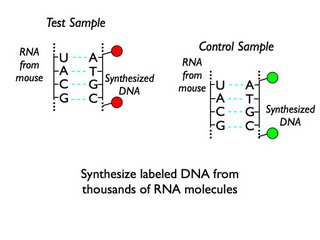
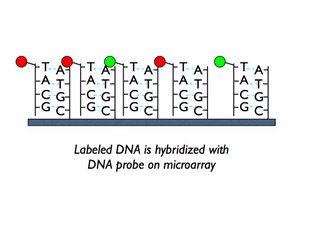
Step 3: Put your fluorescent DNA on the microarray and measure the fluorescence. The fluorescent DNA from the samples matches up, or hybridizes to short segments of DNA that have been printed as spots on a chip; each spot contains DNA for one gene, and a chip containst thousands of genes. The test sample has one kind of fluorescent tag (we'll call it red) and the control sample has another kind (we'll call it green). For each spot you measure how much red fluorescence and how much green fluorescence there is; the readout tells you whether there are more molecules from the test sample or the control sample hybridized to a particular spot. If there is more red on a spot, it means there were more RNA molecules from that gene in the test sample than in the control, and thus that the gene is more highly expressed in the test sample than in the control.
Here is the hybridization at one spot:
And here is a cartoon version of a microarray (remember, a real one has thousands of spots):
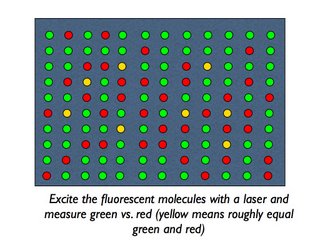
That, in a nutshell, is how you measure gene expression for thousands of genes. Remember, the readout is relative expression - all you can say is how strongly or weakly a gene is expressed in one sample relative to another sample. Measuring absolute levels of RNA requires different technologies, and those technologies haven't yet been adapted for measuring thousands of genes at once.
So after the authors did these experiments for ~300 individual mice (4 samples per mouse - a brain, fat, liver, and muscle sample), they could sit down and analyze their data. One way to represent the data is in a clustering analysis, as shown below:
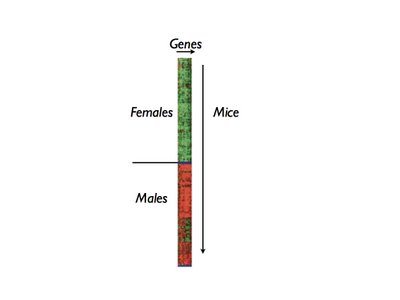
Here is how you read this diagram. It's hard to see this, but the image is made up of several thousand red or green pixels. Each individual pixel represents one individual gene in one individual mouse; the pixel is red if the gene is expressed higher than average in that individual mouse, and green if lower than average. In this plot we are looking at ~40 individual genes, and you can see that these particular genes are expressed higher than average in almost all of the males and lower than average in almost all of the females.
Leaving out a lot of details, that's the general idea of how to measure differences in gene expression on a genome-wide scale.
Men and women share almost identical genomes - all of us have two copies of chromosomes 1-22, and at least one X chromosome. Differences in genes between men and women are limited to a relatively small number of genes on the Y chromosome. So how do sex differences arise? The answer must be in gender differences in gene regulation. These differences are not only responsible for most of the differences in sex characteristics, but also for many of the gender differences in susceptibility to certain diseases and responses to drugs.
Scientists at UCLA looked at genes in 4 major tissue types that are frequently involved in disease: brain, fat, liver, and muscle tissue. Among the genes that were active in those tissues, they found thousands of genes whose expression was sexually dimorphic, or different in males and females. The most dramatic differences were in liver, fat, and muscle cells, but hundreds of genes also showed expression differences in brain tissue. In brain tissue, 13% of the active genes showed sex differences, while in the other 3 tissue types, more than 50% of active genes showed differences.
Interestingly, sexually dimorphic genes were also genes that tended to be tissue specific. For example, some genes that are active in brain tissue are also active in many other tissues types; other genes are active only in the brain and nowhere else - these latter genes are tissue-specific genes. The researchers found that genes active in brain but nowhere else, or liver but nowhere else, etc., were the genes that showed the greatest differences between males and females. This suggests that most sexually dimorphic genes have highly specialized functions.
Most of the expression differences were small - most genes showed less than a 20% difference in expression level. How significant is this? It's hard to say - in many cases that much of a difference may not matter, but there can be situations where this difference alters the kinetics of a process in the cell and leads to gender differences in drug responses or disease development. Many of the genes that showed differences were enzymes, ion-conducting channels, and cell surface receptors, where small differences in expression could conceivably matter.
What does this all mean? What have we learned from this? Large gene expression studies like this don't always produce groundbreaking, concrete findings. Studies like this are most valuable for the new avenues of research they open up, and the data from this study will provide a resource for future, more specific studies. This is not the first paper to report gender differences in gene expression, but this study does show that these differences are much more extensive than we may have realized before. As I mentioned above, this kind of work lays a foundation for understanding why men and women differ in the incidence and progression of many major diseases.
An important question to ask when you look at the results of any research is, How did the researchers know what they claim to know? As I mentioned, this is not the first study to look at gender specific differences in gene expression, but this study is different in two major ways. The authors used over 300 mice (169 females, 165 males), which increases the statistical power of this study - they are able to reliably detect much smaller differences than previous studies. They also used the offspring of a cross between two fairly different strains of mice, as opposed to earlier studies that worked with one inbred strain. The advantage of this is that they are better able to link specific gene expression differences with certain physiological traits that differ between the two mouse strains. I won't go into the technical reasons why this is true - that's a little too much to deal with in this post.
You may be asking just what exactly are "differences in gene expression" and how do you measure these for thousands of genes at a time? In a study like this one, gene expression is defined as differences in the RNA levels. The level of RNA produced from a DNA-encoded gene is really only a proxy for what actually matters physiologically, the level of protein that is ultimately produced. In many cases, RNA can be a pretty good proxy, and RNA levels are much, much easier to measure because you can measure them on a a microarray. Here is how it works:
Step 1: Kill the mice, get the tissue, grind it up and chemically extract the RNA. Researchers have to be careful at this point to avoid cross contamination - for example, you don't want fat tissue in your muscle sample, although in some cases it's probably impossible to avoid all contamination. Also, in this paper the authors took general tissue types, like whole brain tissue, without separating out sub-types, so their results represent a tissue average and will not capture fine-scale expression differences in specialized parts of the brain.
Step 2: Make fluorescently labeled DNA from the RNA. RNA can act as a template to make DNA, and for reasons that will be clear later, you can use this step to incorporate fluorescent tags. When you use microarrays to look at gene expression, you need two samples for each experiment - a test sample (in this case, tissue from an individual male or female mouse), and a control sample which you can compare the test sample against. In this paper the control consisted of a mixed pool of RNA from both male and female mice, which gives an across-the-board average.

Step 3: Put your fluorescent DNA on the microarray and measure the fluorescence. The fluorescent DNA from the samples matches up, or hybridizes to short segments of DNA that have been printed as spots on a chip; each spot contains DNA for one gene, and a chip containst thousands of genes. The test sample has one kind of fluorescent tag (we'll call it red) and the control sample has another kind (we'll call it green). For each spot you measure how much red fluorescence and how much green fluorescence there is; the readout tells you whether there are more molecules from the test sample or the control sample hybridized to a particular spot. If there is more red on a spot, it means there were more RNA molecules from that gene in the test sample than in the control, and thus that the gene is more highly expressed in the test sample than in the control.
Here is the hybridization at one spot:
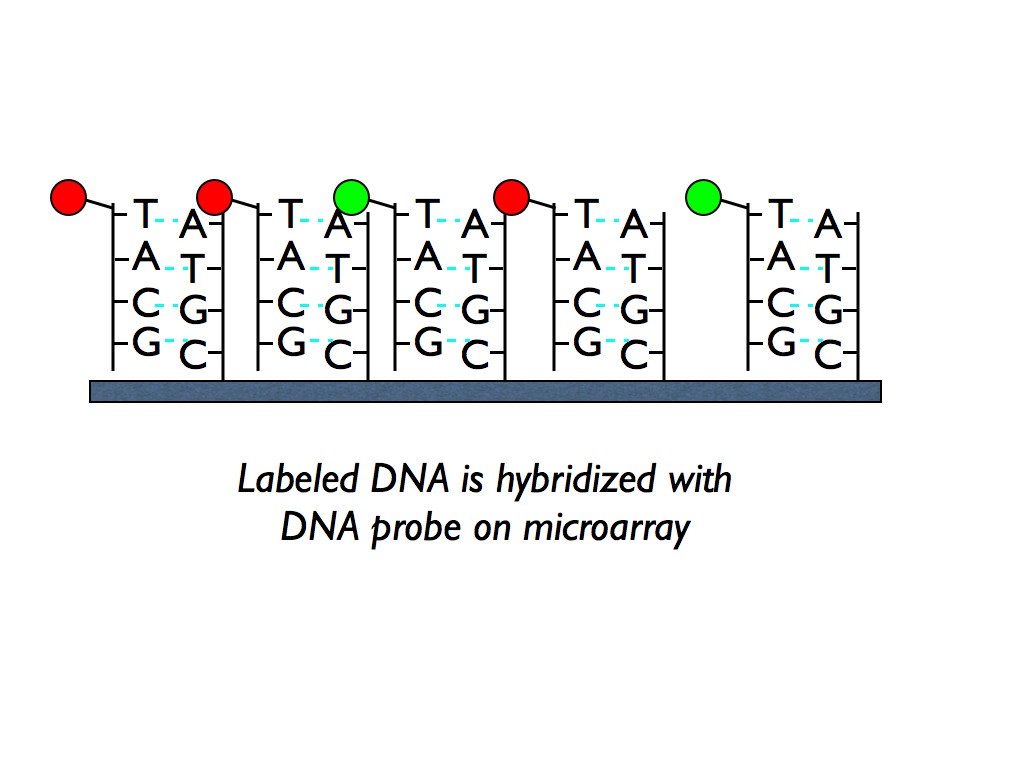
And here is a cartoon version of a microarray (remember, a real one has thousands of spots):

That, in a nutshell, is how you measure gene expression for thousands of genes. Remember, the readout is relative expression - all you can say is how strongly or weakly a gene is expressed in one sample relative to another sample. Measuring absolute levels of RNA requires different technologies, and those technologies haven't yet been adapted for measuring thousands of genes at once.
So after the authors did these experiments for ~300 individual mice (4 samples per mouse - a brain, fat, liver, and muscle sample), they could sit down and analyze their data. One way to represent the data is in a clustering analysis, as shown below:

Here is how you read this diagram. It's hard to see this, but the image is made up of several thousand red or green pixels. Each individual pixel represents one individual gene in one individual mouse; the pixel is red if the gene is expressed higher than average in that individual mouse, and green if lower than average. In this plot we are looking at ~40 individual genes, and you can see that these particular genes are expressed higher than average in almost all of the males and lower than average in almost all of the females.
Leaving out a lot of details, that's the general idea of how to measure differences in gene expression on a genome-wide scale.
Subscribe to:
Posts (Atom)


